
Since 2025 you can also find me at the University of Technology Nuremberg UTN) as Professor of Early Modern Philosophy in LIAS (Department of Liberal arts and Sciences). My research group, or Early Modern Lab, organizes a research seminar (almost) every Wednesday (attendance if free, no registration needed). We are also co-organizing the Princeton-Bucharest-Nuremberg Seminar in Early Modern Philosophy. For our plans and projects see also here.
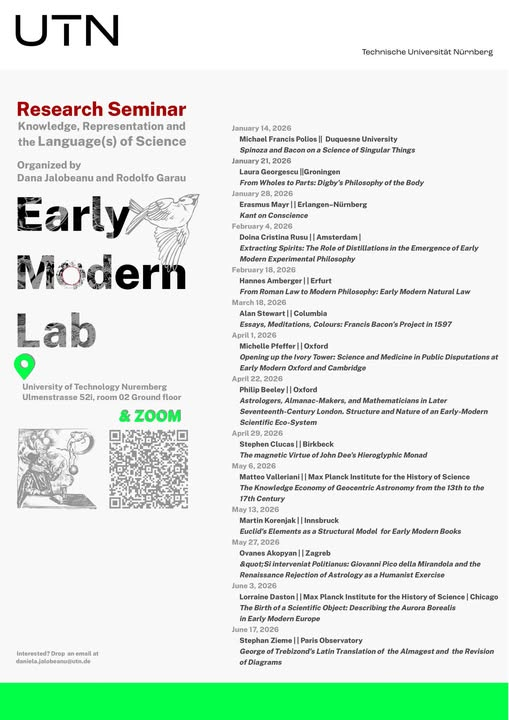
Research Seminar of the Early Modern Lab
Organized by Dana Jalobeanu and Rodolfo Garau, the Research Seminar of the Early Modern Lab meets almost every Wednesday during the term time. Here is a description and the program of the seminar. If you would like to give a talk in our research seminar, drop me an email (daniela.jalobeanu@utn.de).
CfP: Francis Bacon 1626–2026: Four Centuries of Thought, New Horizons for Research
University of Technology Nuremberg (UTN), 12–13 June 2026
On the occasion of the four-hundredth anniversary of the death of Francis Bacon (1561–1626), this international conference aims to reassess Bacon’s philosophical, scientific, literary, and cultural legacy, as well as the complexity of his reception across early modern Europe. The conference is organized by Dana Jalobeanu and Rodolfo Garau at the University of Technology Nuremberg (UTN), thanks to the generous support of a grant from the Thyssen Stiftung. The conference brings together scholars working in Bacon studies and related fields, including early modern philosophy, the history of science, and literary studies, among them Peter Anstey, Claudia Dimitru, Mordechai Feingold, Daniel Garber, Vera Keller, Silvia Manzo, Alan Stewart, Claire Crignon, Richard Serjeantson, Oana Matei, Angus Vine, Grigore Vida, and Cesare Pastorino.
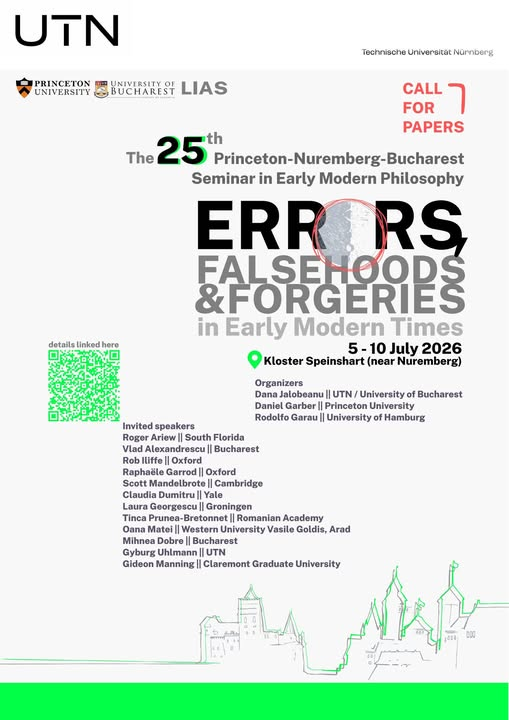
Princeton-Bucharest-Nuremberg Seminar in Early Modern Philosophy, (the 25th edition of the Princeton-Bucharest Seminar in Early Modern Philosophy)
The Oxford Francis Bacon Project
Since 2019 I have joined the Oxford Francis Bacon Project as the editor-coordinator of the Sylva Sylvarum, the first English modern edition of one of Bacon’s most popular works, a natural and experimental history that has shaped, in decisive ways, early modern philosophy and the sciences. Along writing and researching the history, first editions and the reception of Sylva Sylvarum, I am also involved in organizing working groups, workshops and conferences related to this editorial work.
Upcoming conference: Idols, method and the organization of knowledge. A workshop on the De augmentis scientiarum, Organized by Dana Jalobeanu, Daniel Garber, Mogens Laerke and Alan Stewart, Maison Francaise, Oxford, 6-7 November 2025. Program here.

The experimental philosophy of Henry Power: a view from the archives.
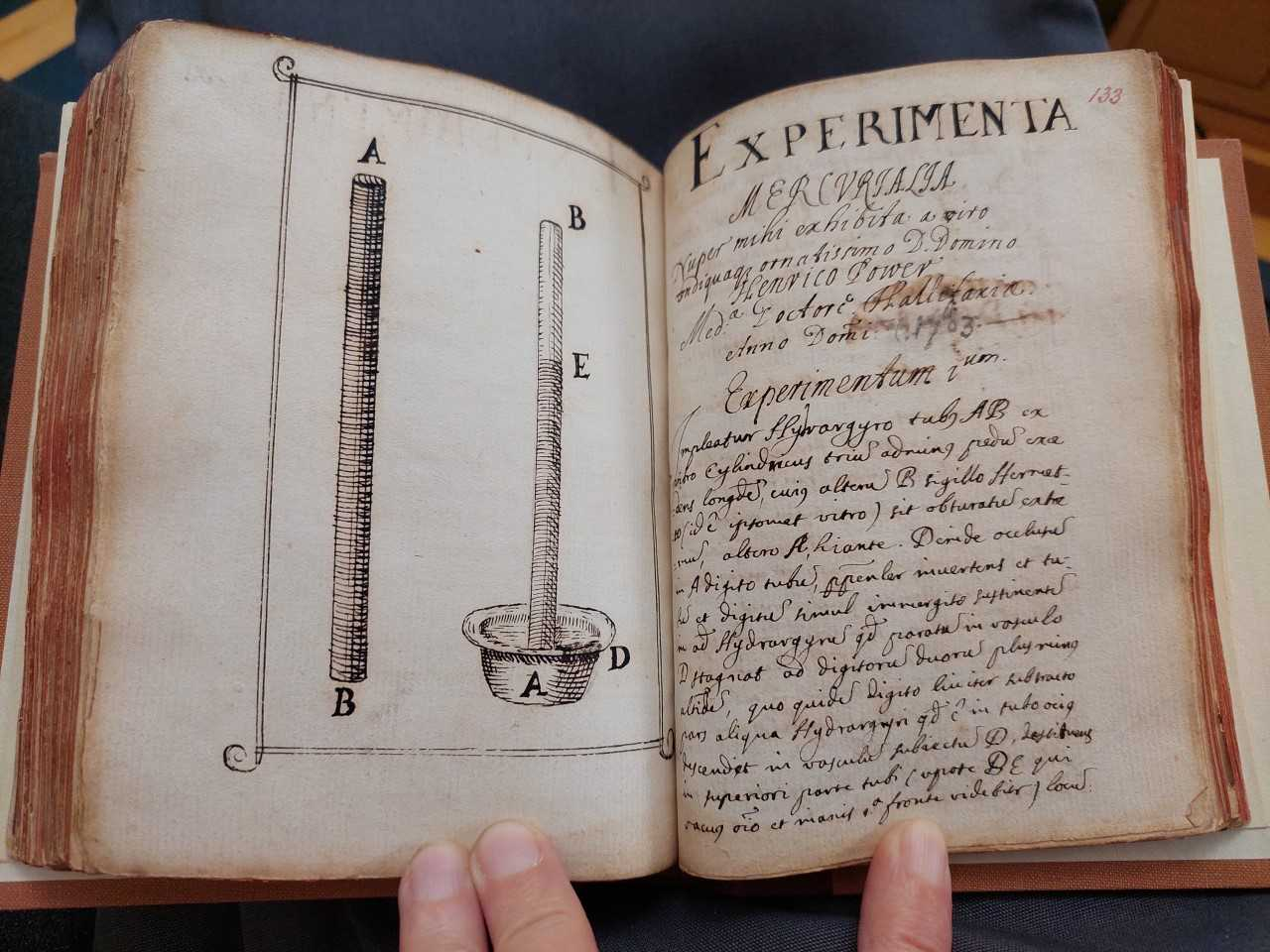
This project aims to offer a better understanding of mid-seventeenth century experimental philosophy and the interplay between natural philosophy, natural history, theology and moral philosophy. Its focus is the archive of the natural philosopher, medical practitioner and humanist Henry Power (1621-1668). Among the outcomes of the project is a workshop on Henry Power to be held at University of Technology, Nuremberg on 1-3 December 2025. Invited speakers: Gideon Manning (Claremont Graduate University), Oana Matei (Western University Vasile Goldis, Arad), Grigore Vida (Romanian Academy). We also plan a special issue of Anals of Science. If you are interested in joining us or proposing a paper for the special issue, get in touch!.
From natural magic to science: the modern impact of natural magic recipes and the European diffusion of Giovanni Battista Della Porta’s Magia naturalis.
Investigating the reception and uses of Giovanni Battista Della Porta’s Magia naturalis in the seventeenth century England, in the context of the emergence of experimental philosophy.
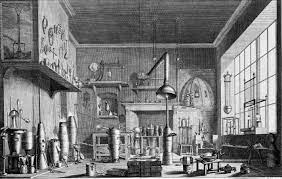
Recipes, technologies and experiments: Enactment and the emergence of modern science
PN-III-P4-ID-PCE-2020-0251
This project aims to investigate that crucial moment in the history of science in which ideas, techniques and strategies coming from natural history, natural magic and medicine fused in the intellectual melting pot of the seventeenth century natural philosophy, giving birth to early modern experiments. The focal point of our investigation is the transformation of knowledge embodied in „recipes,” and the long and complex process through which recipes were transformed into scientific experiments. To date, this process was mainly described in terms of material practices, structures of knowledge and epistemic genres. We aim to approach it with a set of conceptual tools coming from the philosophy of science. Our goal is to provide a philosophical analysis of the complex set of actions that lie behind recording recipes and experiments. We focus on the process of disambiguation through which tacit knowledge embodied in the recipes was gradually spelled out, tried, tested, reformulated and transformed. We call this process “enactment”. A key goal of our project is to define and exemplify forms and strategies of enacting recipes. A second goal is to show that the passage from recipes to experiments is neither straightforward, nor univocal. Enacting recipes does not always lead to scientific experimentation. Sometimes, the end product is something different. We call this alternative product of enactment “technology,” and an important part of this project will investigate the emergence of several such early modern technologies, discussing their complex relations with recipes and experiments.
Other projects:

The emergence of mathematical physics in the context of experimental philosophy
PNIII- P4-ID- PCE 2016-0228
The aim of this project was to undertake a cross-disciplinary investigation into the emergence of a particular form of mathematization, a specific blending, into one compound, of theoretical sciences and experimental methods. We called this mixture “mathematical physics,” to distinguish it from other seventeenth century competing attempts to mix physics and mathematics. Mathematical physics so understood is both an actor’s category and a term we propose for historiographic use. Below are some of our main results:
- Ovidiu Babeș (2018), Descartes and Roberval: The Composite Pendulum and its Center of Agitation, in Journal of Early Modern Studies, 7, issue 1, 123-150.
- Mihnea Dobre, “Rohault, Jacques” article published in the section on “Mechanical Philosophy” of the Springer Encyclopedia of Early Modern Philosophy and the Sciences, edited by Dana Jalobeanu and Charles Wolfe. Springer, 2019. https://doi.org/10.1007/978-3-319-20791-9_155-1.
- Dana Jalobeanu (2020). Francis Bacon’s “Perceptive” Instruments, Early Science and Medicine, 25 (6), 594-617.
- Dana Jalobeanu (2020). Experiments in the Making: Instruments and Forms of Quantification in Francis Bacon’s Historia Densi et Rari, Early Science and Medicine, 25(4), 360-387. doi: https://doi.org/10.1163/15733823-00254P04
- Dana Jalobeanu, Spirits coming alive: the subtle alchemy of Francis Bacon’s Sylva Sylvarum, Early Science and Medicine, 23 (2018) 459-486.
- Dana Jalobeanu, When Mathematics Overtakes Philosophy: The Silent Revolution and the Invention of Science (review article of David Wootton, The Invention of Science: A New History of the Scientific Revolution, Penguin, London, 2016), Journal of Early Modern Studies, 7, issue 1, (2018) 187-195.
- Grigore Vida, Descartes’ Theory of Abstraction in the Regulæ, Journal of Early Modern Studies, vol. 7, issue 1 (2018), 105–121

From natural history to science: The emergence of experimental philosophy
PN-II-ID-PCE-2011-3-0719
The purpose of this project was to trace some of the characteristic features of the early modern experimental philosophy in the natural historical investigations of the late sixteenth century, more precisely, into what we have called “research-oriented natural history.” Here are some of our results:
Jalobeanu, D. (2016a). Disciplining experience: Francis Bacon’s experimental series and the art of experimentation, Perspectives on Science 24 (3) 324-342.
Jalobeanu, D. (2016b). “Borders,” “Leaps” and “Orbs of Virtue:” A Contextual Reconstruction of Francis Bacon’s Extension-Related Concepts, in Boundaries, Extents and Circulations: Space and Spatiality in Early Modern Philosophy, edited by Koen Vermeir and Jonathan Regier, Studies in History and Philosophy of Science 41, Dordrecht: Springer.
Jalobeanu, D. (2016c). “The marriage of physics with mathematics:” Francis Bacon on measurement, mathematics and the construction of a mathematical physics, in The Language of nature. Reassessing the Mathematization of Natural Philosophy in the Seventeenth Century, edited by G. Gordon, B. Hill, E. Slowik and K. Waters, Minnesota Studies in Philosophy of Science, 20: 51-81.
Jalobeanu, D. (2016d). Bacon’s apples: A case study in Baconian experimentation, in Giglioni et. all., Francis Bacon on motion and Power, Dordrecht: Springer: 83-113.
Jalobeanu, D. (2015a). The Art of Experimental Natural History: Francis Bacon in Context, Zeta Books: București (2015), ISBN: 978-606-8266-92-3 (ebook), ISBN: 978-606-8266-93-0 (paperback).
Jalobeanu, D. (2015b). The toolbox of the early modern natural historian: Notebooks, commonplace books and the emergence of laboratory records, Journal of Early Modern Studies 4: 107-123.
Jalobeanu, D. (2015c). Magnificent Principia, Physics Today 68: 45-46.
Jalobeanu, D. (2015d). Robert Boyle’s Experimental Philosophy Revisited, Society and Politics 9: 100-102.
Jalobeanu, D. (2014a). Elements of natural history in Sidereus nuncius, Revue Roumaine de Philosophie 58: 55-77.
Jalobeanu, D. (2014b). The Principia for the common-reader: A New Trend in Newtonian Scholarship?, Societate și Politică 8 (2): 100-103.
Jalobeanu, D. (2014c). A natural history of the heavens: Francis Bacon’s anti-Copernicanism, in The making of Copernicus edited by Wolfgang Neuber, Thomas Rahn and Claus Zittel, special issue of Intersections: Interdisciplinary Studies in Early Modern Culture, Brill: 64-88.
Jalobeanu, D. (2014d). The French reception of Francis Bacon’s natural history in mid seventeenth century, in Elodie Cassan, ed. Bacon et Descartes: Genese de la modernite philosophique, Editions ENS Lyon.
Jalobeanu, D. (2014e). Constructing natural historical facts: Baconian natural history in Newton’s first paper on light and colours, in Zvi Biener, Eric Schliesser, Newton and Empiricism, Oxford: Oxford University Press.
Jalobeanu D., Pastorino, C. (2014). Introduction, in Instruments and arts of inquiry: natural history, natural magic and the production of knowledge in early modern Europe, special issue of the Journal of Early Modern Studies 2.
Jalobeanu, D. (2013a). Learning from experiment: classification, concept formation and modeling in Francis Bacon’s experimental philosophy, Revue Roumaine de philosophie 57: 75-93.
Jalobeanu, D. (2013b). Francis Bacon, Early Modern Baconians and the Idols of Baconian Scholarship: Introductory study, Societate si Politica 7: 5-28.
Jalobeanu, D. (2013c). Four idols of Baconian scholarship, Procedia: Social and Behavioral Sciences, Proceedings of the International Workshop on Historiography of Philosophy, Representations and Cultural Constructions, 71:123-130.
Jalobeanu, D. (2012). Francis Bacon’s natural history and the Senecan natural histories of the early modern Europe, Early Science and Medicine 17 (2): 197-229.
Rusu, D.C. (2017a). Rethinking Sylva Sylvarum: Francis Bacon’s Use of Giambattista Della Porta’s Magia Naturalis, Perspectives on Science, forthcoming.
Rusu, D.C., Lüthy, Ch. (2017b). Extracts from a Paper Laboratory. The Status of Francis Bacon’s Sylva Sylvarum, Intellectual History Review, forthcoming.
Rusu, D.C. (2016). Manipulating matter and its appetites: Francis Bacon on causation and the creation of preternatural. In Contingency and Natural order in Early Modern Science, eds. Pietro Daniel Omodeo and Rodolfo Garau, Boston Studies in the Philosophy and History of Science, Springer, forthcoming.
Rusu, D.C. (2014a). Abolishing the Borders between Natural History and Natural Magic: Francis Bacon’s Sylva sylvarum and the Historia vitae et mortis, Society and Politics 8(2):23-42.
Rusu, D.C. (2014b). Critica autorității și folosirea surselor: Francis Bacon despre compilarea istoriilor naturale. In Etica cercetarii si drepturile de autor, ed. Constantin Stoenescu, Editura Universitatii din Bucuresti:47-84.
Dobre, M. (2016a). Book review of Jacques Rohault, Traité de physique, édition par Simone Mazauric, Paris, Édition du Comité des travaux historiques et scientifiques (Collection CTHS Sciences n° 12), 2014, 830 p. In Artefact. Techniques, histoire et sciences humaines. Le XXe siècle du Technique. Formation, recherché et économie 3:231-235.
Dobre, M. (2016b). Experimental Cartesianism and the problem of space, in Vermeir, Koen and Jonathan Regier (eds.), Boundaries, Extents and Circulations – Space and Spatiality in Early Modern Natural Philosophy. Dordrecht: Springer:153-178. DOI: 10.1007/978-3-319-41075-3_6.
Dobre, M. (2014a). Considerații despre filosofia experimentului în perioada modernă timpurie, Revista de Filosofie 61 (6):631-642.
Dobre, M. (2014b). Mixing Cartesianism and Newtonianism: the Reception of Cartesian Physics in England. In Gianna Katsiampoura (ed.), Scientific Cosmopolitanism and Local Cultures: Religions, Ideologies, Societies, Proceedings of 5th International Conference of the European Society for the History of Science. Athens: National Hellenic Research Foundation/Institute of Historical Research:126-131.
Dobre, M. (2014c). Book review of Manning, Gideon (ed.), Matter and Form in Early Modern Science and Philosophy (Brill, 2012). In British Journal for the History of Science 47: 375-376. DOI: 10.1017/s0007087414000259.
Dobre, D. (2014d). Book review of Lawrence Nolan (ed.), Primary and Secondary Qualities (Oxford University Press, 2011). In Journal of Early Modern Studies (JEMS) 3 (1): 149-153.
Dobre, M. (2013a). Knowledge and Certainty in the Foundation of Cartesian Natural Philosophy, Revue Roumaine de philosophie 57 (1):95-110.
Dobre, M. (2013b). On Glass-Drops: a Case Study of the Interplay Between Experimentation and Explanation in Seventeenth-Century Natural Philosophy, Journal of Early Modern Studies 2: 105-124. DOI: 10.7761/jems.2.1.105.
Dobre, M. (20113c). Material Objects and Circulation of Knowledge in Early Modern Low Countries. Book-review of Sven Dupré and Christoph Lüthy (eds.), Silent Messengers. The Circulation of Material Objects of Knowledge in the Early Modern Low Countries (Berlin: Lit Verlag, 2011) in Society and Politics 7, 1 (13):117-119.
Matei, O. (2015). Husbandry Tradition and the Emergence of Vegetable Philosophy in the Hartlib Circle, Philosophia. International Journal of Philosophy 16 (1):35-52.
Matei, O. (2013). Macaria, the Hartlib Circle, and Husbanding Creation. Society and Politics 7 (2/14):7-33.
Mateiescu, S. (2013a). Philip Melanchthon and the concept of universal experience, Revue roumaine de philosophie 57, 1:111-131.
Mateiescu, S. (2013b). Francis Bacon on potential heat, Society and Politics 7 (1):5-28.
Dumitru, C. (2013). Crucial Instances and Crucial Experiments in Bacon, Boyle, and Hooke, Society and Politics 7 (1):45-61.
Georgescu, L. (2013). One experiment, different uses: floating magnetic bodies in Peregrinus, Norma and Gilbert, Journal of Early Modern Studies 2 (1): 81-103.
 Dana Jalobeanu