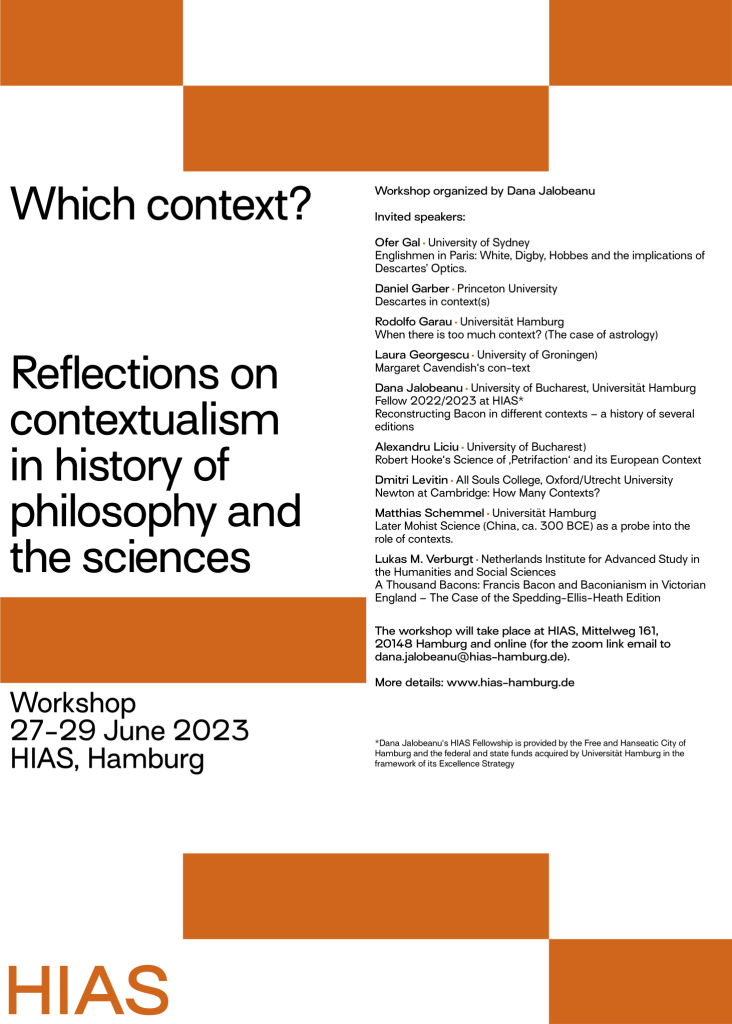
Which Context? Reflections on Contextualism in History of Philosophy and the Sciences Workshop

27-29 July, Hamburg

There seems to be no need to argue for contextualism nowadays; after all, even history of philosophy has succumbed to what has been called the „contextualist revolution.” And yet, it is one thing to say that contextualism is the good practice; and another to detect and specify the „right” context. How does one evaluate and choose the context for a given text or set of practices? Historical objects are so context-sensitive; and meanings can change according to the way you embed the object of your investigation in this or that context. Are there good practices for evaluating contexts? Are these practices discipline-related? Are they historically determined, or mere subject to fashion? The purpose of our workshop is to discuss these and related questions both on case studies, and in their generality. The seminar will take place in the HIAS seminar room at Mittleweg 161. Here is also a zoom link.

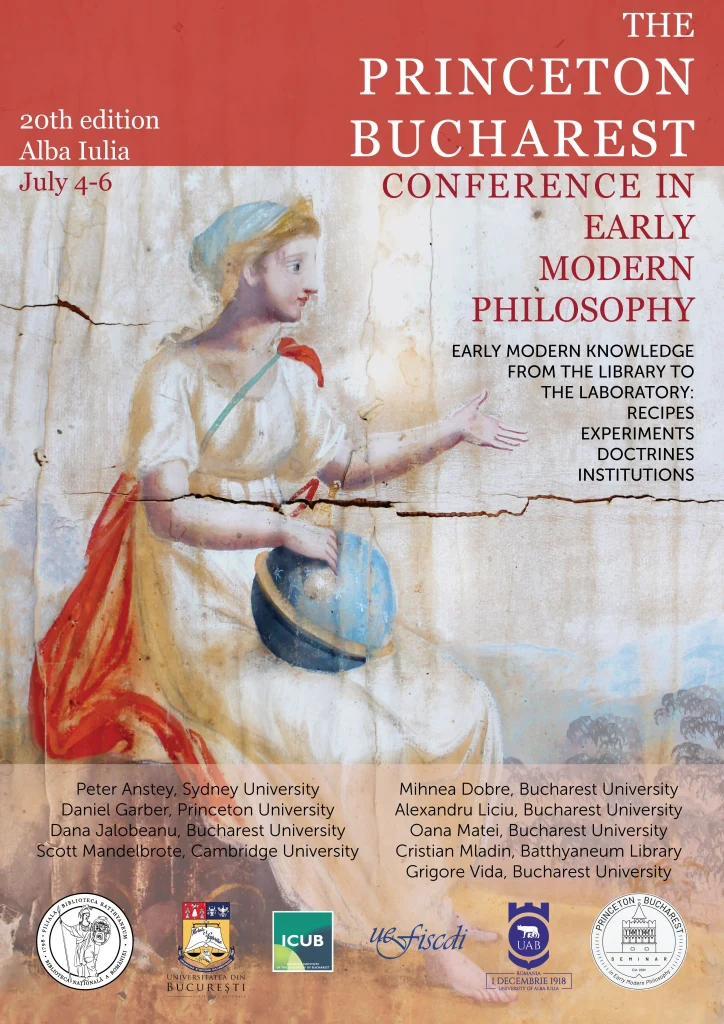
Early Modern Knowledge from the Library to the Laboratory. Recipes, Experiments, Doctrines, Institutions

The Princeton-Bucharest Conference in Early Modern Philosophy, 4-6 July, Alba Iulia

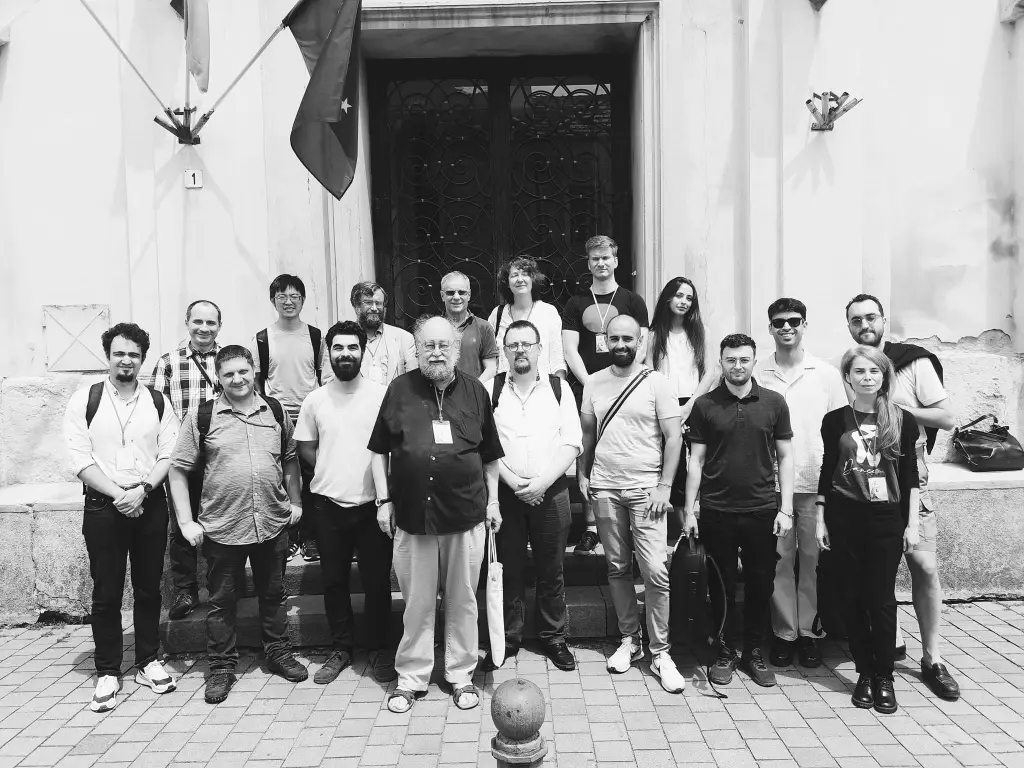
The Princeton Bucharest Conference in Early Modern Philosophy: Recipes and experiments from the library to the laboratory took place between 4 and 6.07.2023, in the beautiful Batthyaneum Library, Alba Iulia. The event brought together scholars working on the early modern thought from Princeton, Bucharest, Cambridge, Sydney and other universities around the world. The Batthyaneum Library seemed the perfect venue not just because of its rich old book collection, but also because it gave us the opportunity to test some of our project research hypotheses regarding the way knowledge was transmitted via recipes, experimental recordings, and natural histories. In this very process, the library along with its reading room became akin to our own „laboratory”, as our project is investigating specifically the transition from the library to the laboratory in producing early modern knowledge.

The founder of the Batthyaneum Library imagined an institution that was to put together the collection of books with the laboratory (in this case the astronomical observatory) and with the instruments of disseminating knowledge (the printing press). The research activity in our project advanced by understanding more about the Batthyneum collections and by sharing our learning with colleagues from other universities around the world. Apart from the core members, such as Dan Garber (Princeton) and Dana Jalobeanu (Bucharest), this year the colloquium benefitted from the participation of the following: Peter Anstey (Sydney), Scott Mandelbrote (Cambridge), Laura Georgescu (Groningen), Cornelis Schilt (Brussels), Ovidiu Babes (Brussels), Oana Matei (Bucharest), Fanhao Meng (Princeton), João Marques Carvalho (Princeton), Jason Yonover (Princeton), Connor Tannas (Princeton), Alexandru Liciu(Bucharest), Anita Drella (Bucharest), Costel Cristian (Bucharest).

Program

10:00-11:00 Tour of the Batthyaneum Library – Cristian Mladin

11:00-12:30 Reading group 1-  Daniel Garber, Dana Jalobeanu, Oana Matei, Grigore Vida, “Merchants of light: experimental philosophers and their libraries”

12:30-14:30 lunch break

14:30-15:05 Dana Jalobeanu, Francis Bacon’s “World of Sciences”

15:05-15:40 Peter Anstey, Locke on Reading

15:40-16:00 coffee break

16:00-16:35 Laura Georgescu, Cavendishian Modality

16:35-17:10 Alex Liciu, Robert Hooke’s Science of “Petrifaction” and its European Sources

17:10-17:30 coffee break

17:30-18:05 Oana Matei, Henry Power on the Palingenesis of Plants

18:05-18:40 João Carvalho, Political Obligation and Freedom of Judgement in Hobbes’s Leviathan

10:00-12:30 Reading group 2 – Peter Anstey, “Locke’s New Method of Commonplacing in Practice”

12:30-14:30 lunch break

14:30-15:05 Scott Mandelbrote, Influence and Evidence: How to Know What Newton Read and When and How He Read It

15:05-15:40 Jason Yonover, Chaos sive Natura: Nietzsche, Spinoza, and Naturalism

15:40-16:00 coffee break

16:00-16:35 Ovidiu Babes, Steffen Ducheyn, The Forgotten Natural Philosophy of Robert Greene (1678?–1730): The Principles of External Objects

16:35-17:10 Connor Tannas, Scepticism and the Synthetic Method

17:10-17:30 coffee break

17:30-20:00 Reading group 3 – Fanhao Meng, “Descartes, Malebranche and the Laws of Nature: Metaphysical and Experimental Approaches”

10:00-12:30 Reading group 4  – Cornelis Schilt, Grigore Vida, “Francis Bacon, The Wisdom of the (Early) Moderns”

12:30-14:30 lunch break 

14:30-15:05 Mihnea Dobre, Constructing a Philosophical System: Claude Clerselier’s Recipe for Cartesianism

15:05-15:40 Tinca Prunea Bretonnet, The Problem of Inclinations and the Berlin Academy in the 1770s

15:40-16:00 coffee break

16:00-18:30 Reading group 5 – Jason Yonover, “Genealogical Arguments”

From recipes and experiments to the investigation of forms: the case of Bacon’s induction

Program

10.45-11.45 Dana Jalobeanu (University of Bucarest), Recipes, experiments and Francis Bacon’s physics of processes. The case of Sylva Sylvarum

12-13 Oana Matei (University of Bucharest & Western University Vasile Goldis, Arad), The reception of Bacon’s experiments with plants in the second part of the 17th century England 

13-15 Lunch break

15-17.30 Afternoon session: slow reading and discussion of Francis Bacon’s Novum organum Book II.

This workshop is organized within the framework of the PCE project Recipes, technologies and experiments: enactment and the emergence of modern science. PN-III-P4-ID-PCE-2020-0251.

The 9th Edition of the Bucharest Graduate Conference in Early Modern Philosophy. 15-16 October 2022.

Keynote speakers: Daniel Garber (Princeton University), Rodolfo Garau (Ca’ Foscari University, Venice)

Venue: ICUB Humanities, 1 Dimitrie Brandza St., 060102, Bucharest, Romania.

It has been a long tradition that early career researchers and graduate students take part in the meetings of the Princeton-Bucharest Seminar in Early Modern Philosophy. To preserve this tradition, the Princeton-Bucharest Seminar has joined forces with the Bucharest Graduate Conference in Early Modern Philosophy, which has just reached its 9th edition! The Graduate Conference will take place on October 15-16, right after the Princeton Bucharest Seminar. Graduate students of both Master’s and PhD levels are encouraged to submit abstracts on any topic related to early modern philosophy by the 1st of September 2022. Abstracts should not exceed 800 words. Each participant will be given 20 minutes to present their paper and another 20 minutes for a Q&A session (40 mins total). The program committee will notify authors of its decision by the 5th of September.

Although we aim to organize the conference in person, a hybrid or an entirely online format remains a possibility, depending on the availability of the speakers to present in person. We will discuss presentation details with each speaker individually.

There is no participation fee. However, we are unable to cover any costs related to travel, accommodation etc.

Please send your abstracts and any other inquiries to bucharestgradconf@gmail.com

This event is organized as part of the Research Project ‘Recipes, Technologies and Experiments: Enactment and the Emergence of Modern Science’, PN-III-P4-ID-PCE-2020-0251. Participants are very welcome to attend both the Seminar (October 14-15) and the Graduate Conference (October 15-16). Stay tuned for more updates!

Update: Consult the conference programme!

Recipes, Experiment and the New Language(s) of Natural Philosophy in Early Modern Europe.

The Princeton-Bucharest Conference in Early Modern Philosophy, in Bucharest, 14-15 October 2022.

Organized by Dana Jalobeanu and Oana Matei at the Research Institute of the University of Bucharest (ICUB-Humanities)

Invited speakers: Daniel Garber, Jennifer Rampling, Hiro Hirai, Vlad Alexandrescu

Speakers: Raffaella Derosa, Christoffer Basse Eriksen, Benjamin Goldberg, Claire Crignon, Oana Matei, Dana Jalobeanu

This will be an in-person meeting, at the ICUB-Humanities (Dimitrie Brandza str. 1, Bucharest, Romania). We aim to bring together historical and philosophical perspectives upon the origins of early modern experiments and the emergence of experimental philosophy.

For the conference programme click here.

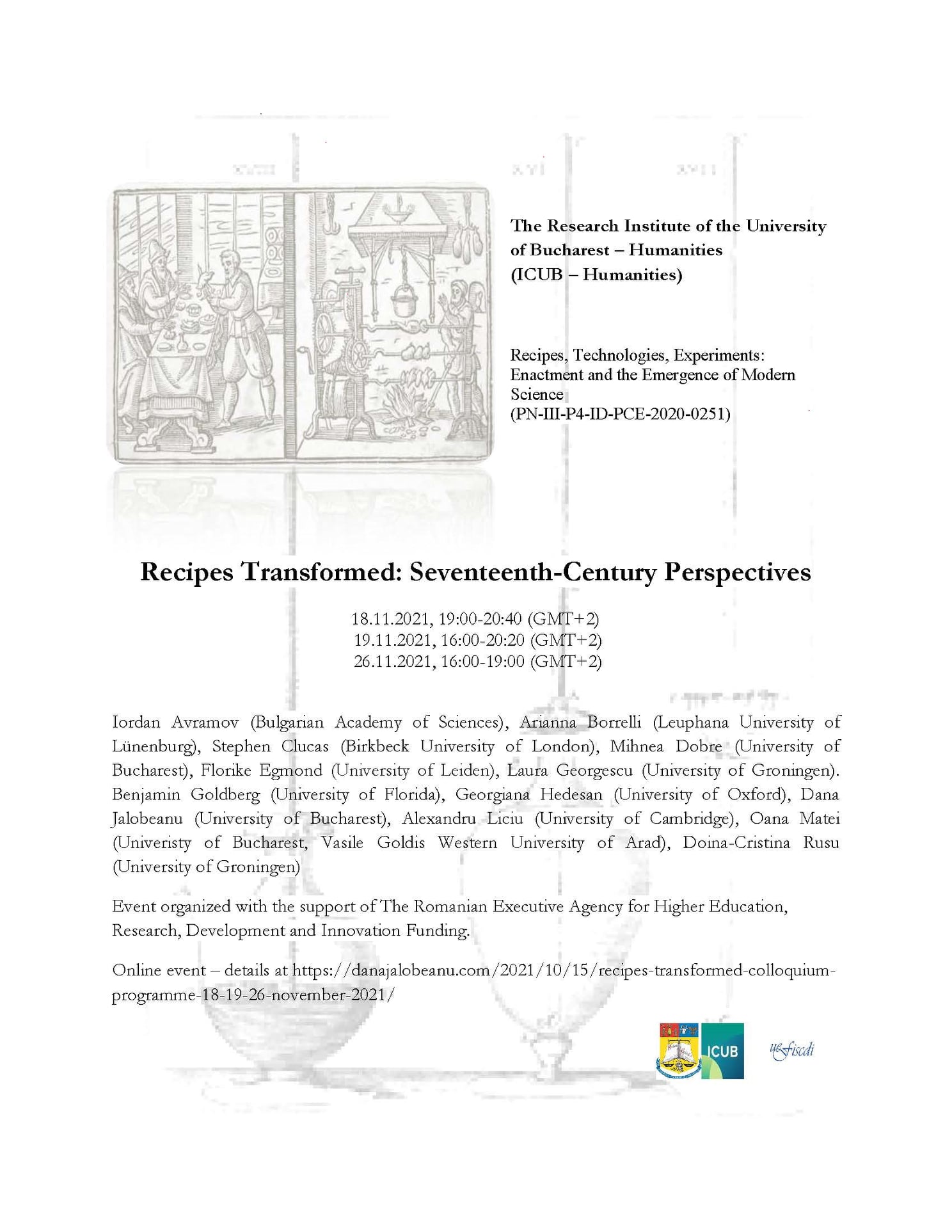
Recipes Transformed, Colloquium Programme, 18-19, 26 November 2021

ICUB-HUmanities, University of Bucharest.

First international colloquium of the research project Recipes, Technologies, Experiments: Enactment and the Emergence of Modern Science (PN-III-P4-ID-PCE-2020-0251). Online

18.11.2021

19:00- 19:20 Welcome Address

19:20-20:00 Arianna Borrelli (Leuphana University of Lünenburg) -Recipes as Tools for Concept Formation in the Work of Giovan Battista Della Porta

20:00-20:40 Dana Jalobeanu (University of Bucharest)The “Missing Results” of Bacon’s Tables: Or Reading the Novum Organum in Context

19.11.2021

16:00-16:40 Stephen Clucas (Birkbeck University of London) – Going with the Alchemical Flow: Schematizing Laboratory Technique in the Late Sixteenth Century

16:40-17:20 Georgiana Hedesan (University of Oxford)Between Incomplete and Philosophical Recipes: Deciphering Van Helmont’s Universal Medicines

17:20-18:00 Alexandru Liciu (University of Cambridge)John Woodward’s “Test” of Observation and the Issue of Civil History

18:00-18:20 Break

18:20-19:00 Laura Georgescu (University of Groningen)Philosophising with Objects: The Role of Artefacts in Digby’s Treatise on Body

19:00-19:40 Doina-Cristina Rusu (University of Groningen) – Distillations, Spirits, and Essences. Experimentation and Matter Theory in the Early Modern Period

19:40-20:20 Mihnea Dobre (University of Bucharest) Constructing Experiments with Glass Drops in Jacques Rohault’s Natural Philosophy

26.11.2021

16:00-16:40 Florike Egmond (University of Leiden) – Cultivating’ the Sea and Reading its Signs: Marine Expertise of the 16th-Century North Sea

16:40-17:20 Benjamin Goldberg (University of Florida) – Concepts of Experience in Royalist Recipe Collections

17:20-17:40 Break

17:40-18-20 Iordan Avramov (Bulgarian Academy of Sciences)Communicating Recipes and Experiments via Letters at the Early Royal Society of London

18:20-19:00 Oana Matei  (University of Bucharest, University of Vasile Goldis, Arad)- Building an Early Modern Science of Vegetation: Nehemiah Grew’s Inquiries into the “Anatomy of Plants”

Recipes Transformed: seventeenth-century perspectives

18, 19 and 24 November 2021

ICUB-HUmanities, University of Bucharest (online)

First international colloquium of the research project Recipes, Technologies, Experiments: Enactment and the Emergence of Modern Science (PN-III-P4-ID-PCE-2020-0251). Online

18.11.2021

19:00- 19:20 Welcome Address

19:20-20:00 Arianna Borrelli (Leuphana University of Lünenburg) -Recipes as Tools for Concept Formation in the Work of Giovan Battista Della Porta

20:00-20:40 Dana Jalobeanu (University of Bucharest) – The “Missing Results” of Bacon’s Tables: Or Reading the Novum Organum in Context

19.11.2021

16:00-16:40 Stephen Clucas (Birkbeck University of London) – Going with the Alchemical Flow: Schematizing Laboratory Technique in the Late Sixteenth Century

16:40-17:20 Georgiana Hedesan (University of Oxford) – Between Incomplete and Philosophical Recipes: Deciphering Van Helmont’s Universal Medicines

17:20-18:00 Alexandru Liciu (University of Cambridge) – John Woodward’s “Test” of Observation and the Issue of Civil History

18:00-18:20 Break

18:20-19:00 Laura Georgescu (University of Groningen) – Philosophising with Objects: The Role of Artefacts in Digby’s Treatise on Body

19:00-19:40 Doina-Cristina Rusu (University of Groningen) – Distillations, Spirits, and Essences. Experimentation and Matter Theory in the Early Modern Period

19:40-20:20 Mihnea Dobre (University of Bucharest) – Constructing Experiments with Glass Drops in Jacques Rohault’s Natural Philosophy

26.11.2021

16:00-16:40 Florike Egmond (University of Leiden) – Cultivating’ the Sea and Reading its Signs: Marine Expertise of the 16th-Century North Sea

16:40-17:20 Benjamin Goldberg (University of Florida) – Concepts of Experience in Royalist Recipe Collections

17:20-17:40 Break

17:40-18-20 Iordan Avramov (Bulgarian Academy of Sciences) – Communicating Recipes and Experiments via Letters at the Early Royal Society of London

18:20-19:00 Oana Matei  (University of Bucharest, University of Vasile Goldis, Arad)- Building an Early Modern Science of Vegetation: Nehemiah Grew’s Inquiries into the “Anatomy of Plants”

Dana Jalobeanu on the Historia et inquisitio de animato et inanimato

In this seminar, Dana Jalobeanu invited us to explore one of  Francis Bacon’s lesser known texts, the Historia et inquisitio de animato et inanimato. Starting from the conditions for the apparition of animated bodies, („an enclosed spirit, heat attenuating and dilating the spirit, soft and sticky matter, and a matrix closed up for the right length of time”), Dana started an investigation into the proper place of the Historia et inquisitio in the broader context of Bacon’s corpus of texts, suggesting that it could provide a roadmap to Bacon’s unwritten 4th part of the Great Instauration.

Dana emphasized that, in this project of a systematic inquiry into the domain of animated matter, we find a convoluted, but technical, terminology (inquisitio as a more advanced part of inquiry than the mere historia; „inquisitio inartificialis et in confuso” vs. „inquisitio artificialis”). An important example of such a technical concept – on which we spent some time – are the „canones mobiles”,  i.e. flexible rules and generalizations that are evolving alongside the process of discovery (and which, as it was suggested by the audience, come from a medical tradition, for which the „canones” represent a series of rules agreed upon by the greatest physicians). The use of canones mobiles is relatively widespread in Bacon’s programme (for instance, in the De vijs mortis we are presented with such a canon: „anything that can be constantly fed, and by feeding be wholly restored, is, like the vestal flame, potentially everlasting”). The terminological discussion led to the question of how are such concepts to be organized and what can this tell us about Bacon’s programme of an experimental natural philosophy. Thus, Dana argued that we should distinguish between ”mother-histories” (the first level of inquiry) and the more advanced inquisitio (exploratory experimentation that can be done at different levels of inquiry). We also examined the theory of matter that underpins the discussion on vivification. For Bacon, „vivification” (the switch from inanimate to animate matter) occurs when the „spirits” that make up the matter are disposed in a specific structure (they are „branched”). What we obtain from this is a continuous taxonomy of the animated bodies, since this account also allows for degrees (some things are more „animated” than others). We took the discussion on step further and asked how is it possible for the artificer to produce artificial life in the laboratory. Dana showed that there are two possibilities on the table (controlling the process of „putrefaction” vs. controlling the matter), and then proposed to look closer at some steps towards the production of artificial life, such as the processes of concoction or of enclosed distillation.

The speaker also received a good number of relevant questions from the audience, such as: what is, in this context, the difference between imitating and perfecting nature? Is the whole universe animated, for Bacon? Can we divide the spirits? Can we produce better animals? What role do limit-cases play in the context of vivification (animals that live in extreme environments, deep ground that ceases to be fertile etc.)? Which sort of things can be vivified and which ultimately can not? (Can we vivify gold? How about Paracelsus’s homunculus? Why shouldn’t we try to reproduce it?) Is vivification related to density and rarity?

Oana Matei on Nehemiah Grew’s science of vegetation

In this seminar, Oana Matei presented her work-in-progress related to the way in which Nehemiah Grew planned to build a science of vegetation, with a focus of his “The Anatomy of Plants”. Oana advanced her provisional thesis that the aim of Grew’s book is to organize different processes of nature into theoretical layers, i.e. in a science of vegetation. Thus, we found out that, for, Grew, “digestion is instrumental to fermentation”, while “fermentation is subservient to vegetation”. These notions, alongside some more details on the way that Grew speaks of generation and motion, gave rise to a discussion on the proper terms that we should use in relation to Grew. Some of us tended to see him as a serious experimentalist (indicating possible connection with Robert Hooke or the medical circle to which Grew belonged), while others emphasized  the vitalistic tone of some of his phrases, or even the bits that rather belong to a mechanical philosophy.

In this context, a number of interesting questions were put on the table. Are some of Grew’s notions of Helmontian influence? In which sense does Grew use the notion of „principles” (Nitrous, Acid, Alkaline, Marine, but he also claims that the atoms are „principles”)? Are they more than mere posits? Why did Grew write an anatomy of plants? To which theoretical level does the anatomy belong? Is Grew part of a larger discussion about the merits of the Ancients vs. the merits of the moderns? (is he engaging with the Hippocratic corpus on generation?). How does Grew reconciliate a physics of processes with geometrical observations (that you only see in an instance)? Is Grew involved in a project of creating artificial life? (and how radical was this?). What is, for him, the difference between biological and non-biological entities? How is Grew’s embryology looking like (how do the structures of pre-established order get intro the seed? Are they there to begin with?).

Experimental Fire. Jennifer Rampling at the Recipes and Enactment Research Seminar

In this meeting we discussed Jennifer Rampling (Princeton University)’s concept of “practical exegetics”, as exposed in her book,  The Experimental Fire (University of Chicago Press, 2020). We focused on chapter two (“Medicine and Transmutation”) and three (“Opinion and Epxerience”) of the book, alongside the text of a scholarly debate between Rampling and William Newman (Indiana University).

Professor Rampling began her presentation with the problem of decknamen, i.e. the issue that in the alchemical literature allegorical names were attributed to different substances, which makes it difficult for the reader to understand what is precisely meant in an alchemical text. This, as professor Rampling showed both in her book and in the presentation that she prepared for us, engenders a philosophically fascinating way of reading these texts, a hermeneutical approach that encompasses both practical and theoretical knowledge. In order to understand this process we could ask how would one learn from the alchemical texts. There are, one Rampling’s account, a few important steps: the alchemy apprentice can start, for instance, from acquiring practical knowledge by working for another person (a craftsman). Then, this practical knowledge has to be somehow related to the books written by the forerunners of alchemy. At this point, we notice that different people bring to the fore different sorts of practical knowledge, but also different education or religious confessions. Thus, when one writes one’s own treatises of alchemy, one realizes a “feedback loop”, in which the way of reading is influenced by one’s practice, while one’s practice is in turn influenced by the readings. This process of balancing practical (performative) knowledge and textual analysis is termed by professor Rampling “practical exegetics”. Moreover, focusing on the persona of George Ripley, a 15th century alchemist, Rampling identifies a tradition forged by practical exegetics, the tradition of “sericonian” alchemy (a way of reading alchemical texts that is built around a mineral/vegetable solvent). The adequacy of this tradition is further called into question by William Newman, who proposed as an alternative an alchemical tradition based on the writings of Roger Bacon. As Rampling has shown, this scholarly debate is itself a perfect example of practical exegetics at work.

The audience had several notable questions and comments that were discussed at large during the seminar. How can we know if the materials used and advocated by different alchemists were the same? Can we divide the alchemical practices according to their end (medical use vs. the transmutation of metals)? Which are the tacit theological assumptions behind the positions of different alchemists? Can there be a moral reading of the alchemical texts (especially focusing on the idea of bettering oneself)? Was there ever the case that alchemy apprentices started from theory rather than from practice? If the alchemical processes and their terminology are not standardized, how about operations (e.g. distillation)? Is there a noticeable difference between natural magic and alchemy when it comes to the issue of testimony and authority?

More on the Recipes and Enactment Research Seminar can be found here: https://danajalobeanu.com/research-seminar-recipes-technologies-and-experiments-enactment-and-the-emergence-of-modern-science/