Course proposal: Supersizing the mind: early modern philosophers and their engineering projects

Course description

Early modern philosophers were bold reformers; they planned to change the world in substantial and durable ways. Historians talked about these plans in terms such as ‘The Scientific Revolution,’ ‘the reformation of thought’, or ‘the origins of the modern mind.’ Each of these reconstructions tells us as much about the fashions and models of the twentieth century thought as about the primary texts they attempted to interpret. It is only natural that 21st century will bring in its own models and fashion(s) into the discussion of early modern projects, seeing them in terms of epistemic cultures, cognitive ecologies, conceptual engineering or distributed cognition.

This course aims to put old texts in a novel perspective, encouraging students to read and reconstruct classical early modern philosophical texts in a context that takes into considerations some of the new trends in cognitive science and the philosophy of AI. We will particularly look at early modern projects of correcting or improving the mind from the current perspective of active externalism and the 4E (embodied-embedded-extended-enacted) models of cognition. We will see that many of the early modern projects involved various ways of “supersizing the mind” (Clarke 2008) and used, to achieve this goal, projects that can be translated in terms of conceptual (or even actual, technical) engineering.

“Supersizing the mind” meant different things for different natural philosophers. Some focused-on supersizing the sense (especially vision). Descartes imagined a prosthetics telescope/microscope attached to the eye; Galileo, Bacon and Hooke devised ‘acousticons’ for enhancing the sense of hearing. Others aimed to enhance and externalize the memory. Others, yet, invented artificial languages and ‘philosophical algebras’ to enhance the computational powers of thought. Many conceived the human imagination, and sometimes even thought and consciousness, as emerging from the collaboration of body and soul, bodily states and processes and interactions with a complex environment, or from an intersubjective ‘contact’ (Lenz, 2022). Some even developed projects of extending the mind throughout ideal communities of researchers who use each-other’s measurements and records, achieving forms of distributed (or perhaps collective) knowledge (Jalobeanu, 2021). To date, very few of these projects were discussed in conjunction with each other; and recent attempts of writing the history of philosophy of mind are still following the traditional path of the emergence and development of the ‘mind-body’ problem (Copenhaver, 2019, Pecere 2020). The twentieth century history of supersizing the mind awaits to be written.

To date, very few of these projects were discussed in conjunction with each other; and recent attempts of writing the history of philosophy of mind are still following the traditional path of the emergence and development of the ‘mind-body’ problem (Copenhaver, 2019, Pecere 2020). The twentieth century history of supersizing the mind awaits to be written.

Aims and objectives

This is a research driven course, based, in part, on my own investigations of Francis Bacon’s projects of supersizing the mind. It reflects on the recent substantial literature on Descartes’ embodied cognition, on recent and less recent literature on Spinoza on embodied mind and consciousness, on recent attempts to make sense of classical and Renaissance thought in terms of distributed cognition, on debates over the representationist (vs. non-representationst) accounts of perception, on Descartes’ transhumanism and its seventeenth-century’ reflection in experimental philosophy, on thinking bodies and thinking machines in the works of Cavendish, Hobbes and Leibniz.

The course aims to offer a novel and inter-disciplinary way of looking at some classical texts. It encourages students to engage with primary and secondary literature, to ask questions still relevant today and learn how to look for new answers. It aims to give an introductory, yet comprehensive picture, while emphasizing both the advantages and the limitations of reading seventeenth century philosophy through presentist lenses.

Methods of teaching and learning

The course will involve no traditional lecturing. Instead, the teacher will function as a ‘resource person’, offering information when required, and providing constant feedback in discussions and to written assignments. Other ‘resource persons’ can be brought in the seminar discussions at the special request of the students.

The group will work as a team, in a reading-group and seminar format. Each meeting will contain at least one hour of slow-reading and discussing a primary text, set within the framework of two conflicting modern interpretations (a more traditional one, in terms of substance-metaphysics and old theories of mind, an a more recent one, formulated in terms of cognitivism and active externalism). The group will be asked to provide arguments pro and con for each of them and students will be encouraged to come up with their own interpretations. The teacher will function, before, during and after these meetings, as a provider of ‘missing information.’ In preparing for the seminar, students are expected to ask questions the teacher will answer. To facilitate communication and the transfer of information, we will use a blog. All the course-materials will be uploaded on the blog. Students can upload their questions at any time. The teacher will provide written answers and reading materials (also uploaded on the blog), as well as comprehensive explanations during the seminar meetings. The principle is simple: the more you ask, the more you know.

When I do not know the answer, we will discuss together whom to approach to find out more. The team of students (plus teacher) will then approach colleagues working in that particular subject, asking questions. Again, the teacher will work as a resource person, helping with information, making suggestions, offering feedback on how to get in touch with experts.

Gradually, and especially from meeting 8 onwards, the role of the resource person will be transferred to the students themselves. For each seminar, one or two of the students will play this role, helping their colleagues with the contexts, explanations, names of experts, supplementary reading materials that will help them understanding better the required readings. 

The students will also have a say in shaping and further improving the syllabus. What you see below is a tentative syllabus organized in four modules: embodied cognition, embedded cognition, extended cognition and enacted cognition. Each of the modules contain three seminars that are well-designed and a list of further topics from which the group can organize seminars-on-request, with external resource persons (i.e., invited speakers) or seminars in which the students will act as resource persons, taking the lead to find further readings and offer the information necessary to prepare the discussion.  

Assignments

There will be two written assignments, one to be performed in collaboration, other to be written individually.

Collaborative assignment: Write a Wikipedia entry on a particular subject (see the list of subjects below).

Students will work in groups of three, with the teacher as a resource person. The first purpose of this assignment is to learn to distinguish between kinds of information (i.e., reference and encyclopaedia articles, academic papers, academic vs. popular books, talks and oral communications etc.) and to learn how to evaluate, select and cite these sources. The second purpose of the assignment is to learn to what extent human cognition is better/different than what AI can do. Students will be allowed to use ChatGTP as a starting point in writing their entry, and will work to correct the resulting text, purging errors, adding information, learning to write more academically (leaving room to questions, further information, using tentative and provisional language and open questions), and learning (on the way) the difference between human writing and machine writing. They might learn quite quickly that it is more economically to write on their own, with the teacher as a resource person, than via ChatGTP, but no intervention will be made to stop them trying].

Individual assignment: a research paper

The second assignment will be optional. Students will be told that they can write a research paper if they want, but that this paper is not compulsory. The writing of the research paper will be presented as a ‘prize’/supplementary benefit of going through the course – they can present their own ideas and get feedback on them, with the condition that they write a research paper (using what they have learned in the first assignment about the distinctions between the research papers and the encyclopaedia entries). For those willing to write, the teacher will provide a time-schedule, and a break-down of the task in ways that facilitate the actual process of writing, working with them on two drafts of the paper (first draft, and a second, cleaner and clearer draft). The purpose of this assignment is to learn what academic writing entails, what are the stages of writing a paper, how important is to have a schedule, in what way one does select from the resources available, what is a claim/thesis, how do we organize an argument, what is the difference between the first and the second draft.

Evaluation

Seminar participation 50 %

Participation in writing the collaborative assignment: 30 % (Mark that the points will be given to the team and that the students will have to divide among themselves according to what they evaluate was each other’s contributions)

Research paper (optional) 20 %

Syllabus

Introduction: the 4E approach and history of philosophy

The introduction will be given under the form of an interdisciplinary discussion in which I will invite colleagues from other Departments of the University, or colleagues from other universities, with expertise on cognitive science, AI and/or the philosophy of AI. The discussion can have a hybrid or online-only format, and it is meant to explain the background project of rewriting history of philosophy (of mind) from the perspective of current research in what mind/intelligence/cognition is and how it works. Students will participate as an audience in this discussion (which can be organized either live or recorded) and will be asked to comment and ask questions (which will be then forwarded to the appropriate experts). After the discussion, teacher and students will get together for an evaluative session in which they will summarize, together, the main points of the discussion, identifying questions, gaps and further points of debate. The teacher will use this framework to describe the objectives, syllabus and main activities of the course.

Unit A: The Embodied Mind

  1. Soul, body and spirit(s) in early modern thought
    1. Short fragments from Pico Della Mirandola Oratio and Marsilio Ficino’s De triplici vita
    1. Francis Bacon, Sylva Sylvarum, short fragments (on the spirits/pneumatics vs. tangible bodies and their interactions, and on the actions of spirits upon imagination, passions)

Secondary bibliography:

D.C.Rusu, Animal spirits: Bridging mind and body in early modern philosophy in Jalobeanu, Wolfe, Encyclopedia of Early Modern Philosophy and the Sciences, Springer 2022

D.P. Walker, Medical spirits and God and the Soul, in Marta Fattori, U. Bianchi, eds. Spiritus, Editione del Ateneo, 1985.

Fabio Tutrone, “The body of the soul. Lucretian echoes in the Renaissance theories on the psychic substance and its organic repartition.” Gesnerus 71.2 (2014): 204-236.

2. Francis Bacon’s embodied mind and the distorted intellect. Idols, corrective epistemology and the theory of ‘helps’ and ‘instruments’ for enhancing the mental powers

Francis Bacon, Novum organum (fragments from book I and II).

Secondary bibliography : Dana Jalobeanu, Superstition, Idolatry and the Advancement of Learning.: From the Brotherhood of Light to the Solomon’s House, Lexicon Philosophicum: International Journal for the History of Texts and Ideas 9 (2021): 11-32; Peter Harrison, Francis Bacon, natural philosophy, and the cultivation of the mind, Perspectives on Science 20.2 (2012): 139-158.

3. Supersizing vision: Descartes and Hooke

Descartes, Dioptrics, Discourse X, Hooke, A general scheme… in Posthumous works (fragments)

Secondary bibliography: Neil M. Ribe, Cartesian optics and the mastery of nature,  Isis 88.1 (1997): 42-61, Boris Jardine, Microscopes, in Lightman, A  Companion to History of Science, Willey, Blackwell, 2016

4. Supersizing memory: from the art of memory to artificial memory projects (Bacon & Hooke)

  • Robert Hooke, Posthumous works (fragments)

Secondary bibliography: Felicity Henderson, Material thoughts: Robert Hooke’s theory of memory, in Manning (ed) Testimonies. States of Mind and States of Body in Early Modern Period, Springer, 2020, Pieters Present,  ‘‘The adding of artificial organs to the natural’: Extended and Distributed Cognition in Robert Hooke’s Methodology’, in Miranda Anderson, and Michael Wheeler (eds), Distributed Cognition in Medieval and Renaissance Culture, Edinburgh University Press, 2019,  Richard Yeo,  “Before Memex: Robert Hooke, John Locke, and Vannevar Bush on External Memory.” Science in Context 20.1 (2007): 21-47.

Seminars to be further designed (at the request and with the participation of the students), subject to choice (we will do maximum 2 out of the following three themes)

  • Intellect restored? (1) Intuitions, clear and distinct ideas & the Cartesian method
    • Descartes, Discourse on method, I-III
  • Integrating the embodied mind: Perception, sensation and reflection in Leibniz
    • Leibniz, On the soul of animals (G VII 330), New Essays (Preface, II, xxi, 4., 72)
  • Embodied mind and the problem of consciousness in Spinoza
    • Secondary bibliography: Steven Nadler, Spinoza on Consciousness, Mind (2008)

Unit B: Mind embedded: artefacts, cultures and artificial environments

5. The ‘world’ of the New Atlantis. Artefacts, natural history and the production of (collective) knowledge

Francis Bacon, New Atlantis

6. Seeing, drawing and engineering: Galileo’s telescope and Hooke’s Micrographia

Secondary bibliography: Owen Gingerich and Albert Van Helden, From occhiale to printed page: the making of Galileo’s Sidereus nuncius.” Journal for the History of Astronomy 34.3 (2003): 251-267, Dana Jalobeanu,  Elements of natural history in Sidereus Nuncius, Revue Roumaine de Philosophie 58.1 (2014): 55-78.

Seminars to be further designed with the collaboration of the students (on request) [chose two out of three]

  • Model societies, scientific utopias and the Republic of Letters (from Bacon’s Solomon’s House to Leibniz’s projects of scientific societies)

Bibliography (Reference):

Jalobeanu, Baconianism in the Royal Society, entry in the Encyclopedia of Early Modern Philosophy and the Sciences

Audrey Borowski, Republic of Letters, entry in the Encyclopedia of Early Modern Philosophy and the Sciences

  • Forms of scientific life: collaborative knowledge vs. distributed knowledge (Bacon vs. Descartes)

Bibliography (Reference):

Miranda Anderson, Distributed cognition in early modern era, entry in the Encyclopedia of Early Modern Philosophy and the Sciences (edited by Dana Jalobeanu and Charles Wolfe)

  • Forms of philosophical life: the salon, the academy, the club and the network

Bibliography (Reference)

J.D. Campbell, A.R. Larsen, Early Modern Women and French Secular Networks, entry in the Palgrave Encyclopedia of Early Modern Women’s Writing, Springer, 2023

Karen Green, Early Modern Women: Society and Sociability, entry in the Encyclopedia of Early Modern Philosophy and the Sciences (Edited by Dana Jalobeanu and Charles Wolfe), Springer, 2022

David S. Lux, Harold J. Cook, Closed circles or open networks?: Communicating at a distance during the scientific revolution, History of science 36.2 (1998): 179-211.

Unit C: The extended mind: cognitive artefacts and social machines. Environmental engineering (and self-engineering)

7. Thinking with objects: maps, diagrams, cognitive metaphors (Galileo, Dialogue, Day I)

8. Artificial languages and philosophical algebras in the Royal Society (Hooke and Wilkins)

Seminars to be further designed with the collaboration of the students (on request) [chose two out of three]

  • Perception, mind and the world in Margaret Cavendish
  • Environmental engineering in Hobbes’s Leviathan
  • Socializing minds: the contact problem and the linguistic model of John Locke
    • Martin Lenz, Socializing minds. Intersubjectivity in Early Modern Philosophy, Oxford University Press, 2022. Chapter 2.

Unit D: Enacted cognition

9. Paper laboratories: books, libraries and other cognitive artefacts

Secondary literature:

Angus Vine, Note-taking and the Organization of Knowledge, entry in the Encyclopedia of Early Modern Philosophy and the Sciences, 2022.

Robert Bunning, Reading practices in Early Modern Europe, in the Encyclopedia of Early Modern Philosophy and the Sciences, 2022

10. Small fragments of recipes and experimental recordings (by the same authors)

Cesare Pastorino, “Beyond recipes: The Baconian natural and experimental histories as an epistemic genre.” Centaurus 62.3 (2020): 447-464, Arianna Borelli, “Giovan Battista Della Porta’s construction of pneumatic phenomena and his use of recipes as heuristic tools.” Centaurus 62.3 (2020): 406-424.

11. Enacting recipes and the emergence of experimental records. The maker’s knowledge tradition.

Francis Bacon, fragments from the Sylva Sylvarum, Henry Power, Experimental philosophy – fragments (optical experiments), Newton, fragments from the first paper on light (1672)

Secondary literature: Dana Jalobeanu, Enacting recipes: Giovan Battista Della Porta and Francis Bacon on technologies, experiments, and processes of nature, Centaurus 62.3 (2020): 425-446.

Seminars to be further designed with the collaboration of the students (on request, maximum 2 out of 4)

  • In search of an artificial language. From Bacon to Wilkins and Hooke

Claudia Dumitru, Artificial languages, entry in the Encyclopedia of early modern philosophy and the sciences, Springer, 2022.

Luca Olivieri, Universal language in Early Modern Philosophy. Between Naturalistic and Artificial Language Schemes, entry in the the Encyclopedia of early modern philosophy and the sciences, Springer, 2022.

  • Leibniz’s thinking machines

D. Rabouin, Introduction, to Leibniz, Characteristica universalis

Dumas Primbauld Simon,  An Ink–and–Paper Automaton: The Conceptual Mechanization of Cognition and the Practical Automation of Reasoning in Leibniz’s De Affectibus (1679),  Societate si politica 13.2 (2019): 87-113.

  • The language of nature and the ‘laboratory’ of the Novum organum

Dana Jalobeanu. “On Metaphysics and Method, Or How to Read Francis Bacon’s Novum organum.” Epistemology & Philosophy of Science 58.3 (2021): 98-119.

  • The art of memory and memory theatres: Bacon’s New Atlantis and Margaret Cavendish’ The Blazing World.

Evelyn Tribble, Memory in the Early Modern Context: Practices and Theories, entry in the Encyclopedia of Early Modern Philosophy and the Sciences (edited by Jalobeanu & Wolfe), Springer, 2022

Helfer, R. (2024). “A Work of Fancy”: World-Making Imagination as an Art of Memory in Margaret Cavendish’s Blazing World. In: Kaethler, M., Williams, G. (eds) Historicizing the Embodied Imagination in Early Modern English Literature. Palgrave Macmillan, Cham.

Bibliography:

Primary:

Francis Bacon, Instauratio Magna: Novum Organum and Related Texts, edited by Graham Rees and Maria Wakeley, volume XI of the Oxford Francis Bacon, Oxford University Press, 2000

Margaret Cavendish, Essential Writings, edited by David Cunning, Oxford University Press, 2019.

Francis Bacon, New Atlantis, edited by David Colclough, Volume XV of the Oxford Francis Bacon, Oxford University Press, 2024

Rene Descartes, A Discourse on Method, Edited by Ian McLean, Oxford University Press, 2006

G.W. Leibniz, New Essays on Human Understanding, translated and edited by Peter Remnant and Jonathan Bennett, Cambridge University Press, 1996

Reference

Dana Jalobeanu, Charles Wolfe (eds), Encyclopedia of Early Modern Philosophy and the Sciences, 3 vols., Springer, 2022

Edwin Hutchins, Distributed cognition, entry in the International Encyclopedia of the Social and Behavioral Sciences. Elsevier Science 138 (2000): 1-10.

Miranda Anderson, M. Wheeler, M. Sprevak, Distributed Cognition in the Humanities, in M. Anderson, M.Wheeler, M. Sprevak, Distributed Cognition in Classical Antiquity, Edinburgh University Press, 2019

Secondary bibliography

Miranda Anderson and Michael Wheeler (eds), Distributed Cognition in Medieval and Renaissance Culture, Edinburgh University Press, 2019.

Andy Clark, Supersizing the mind. Embodiment, Action and Cognitive Extension, Oxford University Press, 2008.

Daniel Garber, Descartes embodied: Reading Cartesian philosophy through Cartesian science, Cambridge University Press, 2001.

R.N. Giere, Distributed Cognition without Distributed Knowling, Social Epistemology, 21 (2007) 313-320

Hajo Greif, Environments of Intelligence. From Natural Information to Artificial Interaction, Routledge, 2017.

R. Helfer,  “A Work of Fancy”: World-Making Imagination as an Art of Memory in Margaret Cavendish’s Blazing World, in M. Kaethler, G. Williams, (eds) Historicizing the Embodied Imagination in Early Modern English Literature, Palgrave Macmillan, 2024.

Edwin Hutchins, Enculturating the Supersized Mind, Philosophical Studies, 152 (2001), 437-446

Edwin Hutchins, Cognition in the Wild, MIT Press, 1995.

Edwin Hutchins, Enaction, Imagination and Insight, in John Stewart et. all., Enaction. Towards a New Paradigm for Cognitive Science, MIT Press, 2010.

Barnaby R. Hutchins, Christoffer Basse Eriksen, and Charles T. Wolfe, The embodied Descartes: Contemporary readings of L’Homme, in Delphine Antoine Mahut and Stephen Gaukroger, eds., Descartes’ Treatise on Man and its Reception Springer, (2016): 287-304.

Dana Jalobeanu, The Art of Natural History: Francis Bacon in Context, Zeta Books, Bucharest, 2015

Dana Jalobeanu, Superstition, Idolatry and the Advancement of Learning.: From the Brotherhood of Light to the Solomon’s House, Lexicon Philosophicum: International Journal for the History of Texts and Ideas 9 (2021): 11-32.

Martin Lenz, Socializing minds. Intersubjectivity in Early Modern Philosophy, Oxford University Press, 2022

Rhodri Lewis, A kind of sagacity: Francis Bacon, the ars memoriae and the pursuit of natural knowledge,  Intellectual History Review 19.2 (2009): 155-175.

Steven Nadler, Spinoza and Consciousness, Mind 117 (2008) 575-601

Pieters Present,  ‘‘The adding of artificial organs to the natural’: Extended and Distributed Cognition in Robert Hooke’s Methodology’, in Miranda Anderson, and Michael Wheeler (eds), Distributed Cognition in Medieval and Renaissance Culture, Edinburgh University Press, 2019.

A Simmons, Changing the Cartesian Mind. Leibniz on Sensation, Representation and Consciousness, The Philosophical Review, 2001.

Manning, Gideon. “Descartes’ Healthy Machines and the Human Exception.” In Daniel Garber and Sophie Roux (eds.), The Mechanization of Natural Philosophy, 237-262. Dordrecht: Springer, 2013

D.P. Walker, Medical spirits and God and the Soul, in Marta Fattori, U. Bianchi, eds. Spiritus, Editione del Ateneo, 1985.

Richard Yeo, Before Memex: Robert Hooke, John Locke, and Vannevar Bush on External Memory, Science in Context 20.1 (2007): 21-47.

Francis Bacon și construcția imaginară a științei moderne

Curs opțional

Vineri, 10-14 (Amfiteatrul CRM, Facultatea de filosofie)

Francis Bacon este numele cel mai des citat atunci când se discută fundamentele modernității europene. Cu el începe filosofia modernă, spun unii; Bacon este întemeietorul științei moderne, sau măcar al ideologiei științifice din care se naște modernitatea. În scrierile lui găsim prima teorie filosofică a progresului cunoașterii; primul model ideal al unei societăți științifice pan-europene; primul proiect de producere cumulativă a cunoașterii experimentale. Pe de altă parte, ne spun alte interpretări, Bacon a fost mai degrabă un vizionar cu talente literare; știința pe care el o visa n-are mare legătură cu știința care s-a născut mai târziu, în secolul al XVII-lea. Ce ne-a lăsat Bacon moștenire este o construcție imaginară: Casa lui Solomon, din Noua Atlantidă, despre care s-a spus că este „jumătate societate secretă, jumătate institut de cercetare.” Mai sunt și cei care leagă ideologia baconiană de colonialism, supremația omului alb și „torturarea naturii.” Cine are dreptate?

Acest curs își propune să evalueze contribuția lui Francis Bacon în istoria filosofiei – și, mai larg, în istoria gândirii europene. Vom pune în discuție lecturile și interpretările curente, arătând că ele se bazează pe o insuficientă cunoaștere a textului primar. Vom citi împreună câteva dintre textele fundamentale pe care se construiește filosofia lui Bacon și vom învăța să trasăm liniile de forță ale proiectului său. Vom discuta apoi modul în care proiectul baconian a fost receptat în Revoluția Științifică și dincolo de ea.

Cursul propune o abordare teoretic-analitică a unor subiecte din istoria filosofiei. El se adresează în principal studenților de master de anul II de la masteratul de Filosofie și gândire critică, dar este deschis, în principiu, oricărui student doritor. Prelegerile de curs vor fi in format hibrid (linkul de zoom:

Join Zoom Meeting
https://us02web.zoom.us/j/85335695727?pwd=NzRaeFNiTVJjaS9Qa2wyVDRoUHMyQT09

Meeting ID: 853 3569 5727
Passcode: 472819)

Seminarul se va desfasura la Facultatea de filosofie, iar prezenta este obligatorie. Formatul: slow reading și interpretare de text.

Pentru seminar; Vom folosi traducerile realizate de Dana Jalobeanu și colaboratorii ei (vezi bibliografie) dar și noua ediție The Oxford Francis Bacon. Studenții vor învăța cum se face muncă de documentare și editare. Vom lucra împreună la volumul III din Francis Bacon, Opere filosofice, editat de Dana Jalobeanu (la editura Humanitas) învățând care sunt elementele de bază ale unei ediții critice.

Teme de cursuri:

  1. Tema „progresului cunoașterii” și modul în care evoluează recepția lui Francis Bacon în ultimii 300 de ani. Baconianismul secolului al XIX-lea. Ediția victoriană a scrierilor lui Bacon și Noul Organon. Cum s-a constituit canonul (și ce rol a avut teoria inductivă a cunoașterii științifice în constituirea lui). Francis Bacon și filosofia științei.
  2. Bacon în secolul al XVII-lea. Cum au supraviețuit scrierile lui Bacon și din ce s-a construit „baconianismul” științei moderne.
  3. Noua Atlantidă  și continuările sale. Casa lui Solomon și tema „utopiei științifice”
  4. Istorii naturale și experimentale. Ce fel de experimente? (Francis Bacon și filosofia experimentului științific)
  5. Instauratio magna: planul și realizarea. Există un „sistem baconian”?
  6. Idolii minții umane, superstiția și căutarea unei teorii a adevărului (în științe)
  7. De ce are știința nevoie de istorie?
  8. De ce are știința nevoie de poezie? Teoria baconiană a fabulei și tradiția prisca sapientia
  9. De ce are știința nevoie de o hartă a cunoașterii? Tema baconiană a progresului cunoașterii și „originile modernității europene”.
  10. Cum funcționează Casa lui Solomon? Povestea științei și agregarea comunitară

Cursuri „bonus” (la alegere)

  1. Povestea științei și societățile „baconiene” ale secolului al XVII-lea.
  2. Difuzarea modelului Casei lui Solomon în Revoluția Științifică
  3. Difuzarea modelului „Casei lui Solomon” în Europa Luminilor.

Seminar

Cursul va avea și 2 ore de seminar, organizate sub forma de reading group, pe texte selecționate din lista de mai jos.

  1. Francis Bacon, Cele două cărți despre excelența și progresul cunoașterii, Cartea I și selecțiuni din Cartea a II-a.
  2. Abraham Cowley, A proposal for the experimental philosophy, in Dana Jalobeanu, Casa lui Solomon sau fascinația utopiei, Editura ALL, 2011.
  3. Francis Bacon, Noua Atlantidă, traducere de Dana Jalobeanu, Editura Nemira 2007
  4. Francis Bacon, Sylva Sylvarum, fragmente, în Francis Bacon, Opere filosofice II, Sylva Sylvarum sau o istorie naturală în zece centurii, Editura Humanitas, 2017
  5. Francis Bacon, Prefața și Distributio operis (materialele introductive ale proiectului Instauratio magna), din Instauratio magna I: Novum organum and related texts; editată de Graham Rees și Maria Wakeley, OUP, 2000
  6. Francis Bacon, Parasceve, in Prefața și Distributio operis (materialele introductive ale proiectului Instauratio magna), din Instauratio magna I: Novum organum and related texts; editată de Graham Rees și Maria Wakeley, OUP, 2000
  7. Francis Bacon, Noul organon, cartea I

Bibliografie

Francis Bacon, Noua Atlantidă, traducere de Dana Jalobeanu, Editura Nemira 2007

Francis Bacon, Opere filosofice I, traducere de Dana Jalobeanu și Grigore Vida, studii introductive de Dana Jalobeanu, Humanitas, 2022

Francis Bacon, Opere filosofice II, Sylva Sylvarum sau o istorie naturală în zece centurii, Editura Humanitas, 2017

Francis Bacon, Instauratio magna I: Novum organum and related texts; editată de Graham Rees și Maria Wakeley, OUP, 2000

Stephen Gaukroger, Francis Bacon and the transformation of early modern philosophy, Cambridge University Press, 2001

Dana Jalobeanu, The Art of Experimental natural history. Francis Bacon in Context. Editura Zeta Books, 2015

Dana Jalobeanu, ed. Casa lui Solomon sau fascinația utopiei, Editura ALL 2011.

Richard Serjeantson, “The Division of a Paper Kingdom: The tragic afterlives of Francis Bacon’s manuscripts.” Archival Afterlives. Brill, 2018. 29-71.

Lukas Verburgt, ‘Is there a Reader who can Handle it with any Comfort?’: A Brief Publication History of the Works of Francis Bacon. Notes and Records. 2023 Feb 1;77(1):213-20.

Lukas Verburgt, “The Works of Francis Bacon: A Victorian Classic in the History of Science.” Isis 112.4 (2021): 717-736.

Brian Vickers, “Francis Bacon and the progress of knowledge.” Journal of the History of Ideas 53.3 (1992): 495-518.

The 9th Edition of the Bucharest Graduate Conference in Early Modern Philosophy. 15-16 October 2022.

Keynote speakers: Daniel Garber (Princeton University), Rodolfo Garau (Ca’ Foscari University, Venice)

Venue: ICUB Humanities, 1 Dimitrie Brandza St., 060102, Bucharest, Romania.

It has been a long tradition that early career researchers and graduate students take part in the meetings of the Princeton-Bucharest Seminar in Early Modern Philosophy. To preserve this tradition, the Princeton-Bucharest Seminar has joined forces with the Bucharest Graduate Conference in Early Modern Philosophy, which has just reached its 9th edition! The Graduate Conference will take place on October 15-16, right after the Princeton Bucharest Seminar. Graduate students of both Master’s and PhD levels are encouraged to submit abstracts on any topic related to early modern philosophy by the 1st of September 2022. Abstracts should not exceed 800 words. Each participant will be given 20 minutes to present their paper and another 20 minutes for a Q&A session (40 mins total). The program committee will notify authors of its decision by the 5th of September.

Although we aim to organize the conference in person, a hybrid or an entirely online format remains a possibility, depending on the availability of the speakers to present in person. We will discuss presentation details with each speaker individually.

There is no participation fee. However, we are unable to cover any costs related to travel, accommodation etc.

Please send your abstracts and any other inquiries to bucharestgradconf@gmail.com

This event is organized as part of the Research Project ‘Recipes, Technologies and Experiments: Enactment and the Emergence of Modern Science’, PN-III-P4-ID-PCE-2020-0251. Participants are very welcome to attend both the Seminar (October 14-15) and the Graduate Conference (October 15-16). Stay tuned for more updates!

Update: Consult the conference programme!

Recipes, Experiment and the New Language(s) of Natural Philosophy in Early Modern Europe.

The Princeton-Bucharest Conference in Early Modern Philosophy, in Bucharest, 14-15 October 2022.

Organized by Dana Jalobeanu and Oana Matei at the Research Institute of the University of Bucharest (ICUB-Humanities)

Invited speakers: Daniel Garber, Jennifer Rampling, Hiro Hirai, Vlad Alexandrescu

Speakers: Raffaella Derosa, Christoffer Basse Eriksen, Benjamin Goldberg, Claire Crignon, Oana Matei, Dana Jalobeanu

This will be an in-person meeting, at the ICUB-Humanities (Dimitrie Brandza str. 1, Bucharest, Romania). We aim to bring together historical and philosophical perspectives upon the origins of early modern experiments and the emergence of experimental philosophy.

For the conference programme click here.

Announcement

20 month full-time job, postdoctoral position

The ICUB-Humanities, University of Bucharest is opening a full-time position for postdoctoral researcher within the framework of the project “Recipes, Technologies, Experiments: Enactment and the Emergence of Modern Science” (PN-III-P4-ID-PCE-2020-0251), PI Dana Jalobeanu.

Duration: 20 months.

Job description: The successful candidate will work with Dana Jalobeanu and her team in Bucharest. The purpose of the project is to investigate and understand the ways in which the traditional „recipe-format” was gradually transformed, during the seventeenth century, into ways of recording more similar with the „proper” scientific experiment. The successful candidate is expected to take full part in the online and face-to-face activities of the team, to work on a research theme of his/her own (for details see Recipes, ‘technologies’, experiments: Enactment and the emergence of modern science – Dana Jalobeanu) to help with organizing events and project administration. Working as a part of a small and integrated team of historians and philosophers of science will offer expertise and motivation for a future career in the field.

Requirements:

1. Applicants should have a PhD diploma on a topic that relates to the study of early modern thought or philosophy of science.

2. Applicants should have two year experience in research activities or in teaching in the academic field. Four year experience in other domains is acceptable. 

3. Applicants should already have a research profile or display a strong interest in a research career (documented by publications/submissions of papers for publication and by having taken part in research-related events, such as workshops, conferences etc.). All these must relate to the study of the early modern thought.

4. English, including the ability to read sixteenth and seventeenth century old books and manuscripts, at least basic notions of Latin. 

The application file will consist of two packages. The „scientific package” will contain: a CV (including a list of publications), a letter of intention and a sample writing. These will be sent by email to dana.jalobeanu@filosofie.unibuc.ro. The administrative package will be sent by email to concursuri@hr.unibuc.ro.  For the content of the administrative package consult https://unibuc.ro/wp-content/uploads/2018/12/Continutul-dosarului-de-concurs-CS-III-CS-AS.pdf. For additional information send an email to: concursuri@hr.unibuc.ro.

Deadline: 28.04.2022

https://euraxess.ec.europa.eu/jobs/736787
https://jobs.research.gov.ro/anunt.php?id=4870

Știință și pseudo-științe (2022)

Dana Jalobeanu și Gheorghe Ștefanov

Cursul se adresează studenților de la masteratul de Filosofie și gândire critică însă poate fi luat, în regim de curs opțional, de studenții de la oricare dintre masterele Facultății de filosofie (și de studenți de la alte mastere ale UB). Este un curs introductiv de filosofia științei, axat pe problema demarcației dintre știință și pseudo-științe. Scopul cursului este să discute diferitele formulări ale problemei demarcației, și diferitele soluții propuse pentru formularea unui criteriu de demarcație.

Cursul va fi desfășurat modular: primele 6 cursuri vor fi predate de Dana Jalobeanu, următoarele 7 de Gheorghe Ștefanov.  Forma de desfășurare: online

Curs 1 – joi 17 februarie (Dana Jalobeanu)  Știință, pseudo-știință, science-fiction.

O discuție despre concepte și categorii pe un studiu de caz. Cum se constituie „știința shakespereologiei” și teoriile conspiraționiste de tip „Bacon is Shakespeare”

Curs 2: joi 24 februarie (Dana Jalobeanu) Caracterul istoric al problemei demarcației. Teoria aristotelică a scientia și identificarea pseudo-științelor.

Studiu de caz: astrologia (și alte „științe vestigiale”)

Seminar (Gheorghe Ștefanov ): K.R. Popper despre criteriul de demarcație (Conjectures and refutations, și Curd and Cover) – în drop-box, I. Lakatos, Știință și pseudo-știință (în drop-box)

Curs 3: joi 3 martie (Dana Jalobeanu) Forme normative ale demarcației: teorie versus practici

Seminar (Dana Jalobeanu) Feleppa, Robert, 1990. “Kuhn, Popper, and the Normative Problem of Demarcation”, pp. 140–155 in Patrick Grim (ed.) Philosophy of Science and the Occult, 2nd ed, Albany: State University of New York Press, (cartea se găsește în drop-box) Kuhn, T. Logic of Discovery or Psychology of Research?, in Grim (ed), 106-114 (sau Curd & Cover Philosophy of Science.,11-20)

Cursul 4: Joi 10 martie (Dana Jalobeanu) Criterii cumulative ale demarcației și tema bunelor practici. Studiu de caz: astrologia (2)

Seminar (Dana Jalobeanu): Thagard, P. Why Astrology is a Pseudo-science? In Curd, Cover, 27-38 (în drop-box), Michael Gordin, Vestigial sciences (cap.2 On the fringe) in drop-box

Suplimentar: Cap. 6 din Sciences and the Paranormal – astrology, moon effects, bioritm (în drop-box)

Cursul 5 (Dana Jalobeanu):  Joi 17 martie. Drumul către pseudo-știință.

Explicația și acumularea de dovezi explicative, rezistența pseudo-științelor la respingeri și strategiile de apărare (să punem la lucru ce-am învățat până acum de la Lakatos). Studiu de caz: Velikovski.

Seminar: Terence Hines (Pseudoscience and the Paranormal, Prometheus Books, 1988) (p. 228-233), Michael B. Gordin, The Pseudo-sciece wars, cap. 4 (cărțile se găsesc în drop-box)

Cursul 6 (Gheorghe Ștefanov): Joi 24 martie. Bune practici în activitatea științifică. Surse și credibilitatea surselor.

Seminar (Gheorghe Ștefanov). Studiu de caz – „(pseudo) științele paranormalului (Reality Check: Are the Sources Credible?” (pp. 51-64).Cap. 3 din Jonathan C. Smith)

Cursul 7 (Dana Jalobeanu): Joi 31 martie – Bune practici (2). Comunități științifice funcționale și comunități nefuncționale. Predatory vs. genuine în lumea lui „publish or perish”: cum ne dăm seama?

Studiu de caz: Royal Society for the Advancement of Learning. Prima societate științifică înființată în Europa, și singura cu o existență continuă de aproape 400 de ani. Găsiți aici câte ceva despre istoria ei și aici colecția ei de reviste (inclusiv primele numere din Philosophical trasactions, începând cu 1665).

Seminar (Dana Jalobeanu): Vom discuta despre bunele practici de funcționare ale Royal Society. Am pus în drop-box două articole de enciclopedie care să vă dea backgroundul istoric, carta de înființare a Royal Society și niște pagini din prima „Istorie” a RS (Thomas Sprat, History of the Royal Society).

Prin contrast, ne vom uita peste practicile numite „predatory” și asaltul imposturii. Puteți începe de aici.

Concluzii la prima parte a cursului:

O lucrare rezumativă și concluzivă: Thomas Nickles. The problem of demarcation: History and future, in Piggliuci, Philosophy of the pseudo-sciences (în Drop-box)

Cursul 8: Joi 7 aprilie (Gheorghe Ștefanov) – Cunoaștere științifică și cunoaștere comună

Seminar (Gheorghe Ștefanov): Ernst Nagel – Știința și simțul comun (în Dropbox)

Cursul 9 (Gheorghe Ștefanov): Joi 14 aprilie – Cunoaștere științifică și cunoaștere comună (continuare)

Seminar (Gheorghe Ștefanov): Gilbert Ryle – Lumea științei și lumea de fiecare zi (în Dropbox)

Vacanța de Paște

Cursul 10 (Gheorghe Ștefanov): Joi 5 mai – Pseudo-cunoaștere – studiu de caz (1): ghicitul viitorului

Seminar: Cicero – Despre divinație (Polirom, Iași, 1998), Cartea întâi, pp. 41-65, 81-114, și Cartea a doua, pp. 117-141 (cartea se găsește în Dropbox)

Cursul 11: Joi 12 mai  (Gheorghe Ștefanov) – Ghicitul viitorului (continuare)

Seminar: Cicero – Despre divinație (Polirom, Iași, 1998), Cartea a doua, pp. 141-181, 197-9

Cursul 12: Joi 19 mai (Gheorghe Ștefanov) – Pseudo-cunoaștere – studiu de caz (2): Medicina alternativă

Seminar: Terence Hines – Health and Nutrition Quackery (în Dropbox)

Opțional: Jonathan C. Smith – Energy Treatments and Complementary and Alternative Medicine (CAM), în Pseudoscience and Extraordinary Claims of the Paranormal – A Critical Thinker’s Toolkit, pp. 269-283 (cartea se găsește în Dropbox)

Cursul 13: Joi 26 mai (Gheoghe Ștefanov) – Pseudo-cunoaștere – studiu de caz (3): Vindecarea prin credință

Seminar: Terence Hines – Faith Healing (în Dropbox)

Opțional: Jonathan C. Smith – Supernatural Cures and Faith Healing, în Pseudoscience and Extraordinary Claims of the Paranormal – A Critical Thinker’s Toolkit, pp. 284-302 (cartea se găsește în Dropbox)

Dacă mai este timp: Terence Hines – Current Trends in Pseudoscience (în Dropbox)


58

Lucilius îl salută pe Lucius ( Caro Lucio Lucilius salutem dat).

Mă bucur că mi te-ai destăinuit în scrisoarea anterioară și că încercările prin care ai trecut, de-a lungul călătoriei tale la Neapolis, ți-au oferit șansa de a medita asupra propriilor reacții naturale. Uneori încercările sorții vin cu numeroase împliniri pe care rareori avem abilitatea de a le identifica. De cele mai multe ori suntem copleșiți de neplăceri și suferințe care ne supără și ne orbesc rațiunea de-a binelea, așa cum tu bine ai sesizat în scrisoarea pe care mi-ai trimis-o – dar peste ele, un suflet puternic trebuie să treacă fără să șovăiască.

Că tot veni vorba de încercări, în aceste ultime zile am trecut și eu printr-o situație ca a ta, doar că eu m-am confruntat cu un altfel de obstacol, unul de gândire, meditativ, de înțelegere a lumii în totalitatea ei. În timp ce meditam la lucrurile înconjurătoare, mi-a răsărit în minte ideea următoare: ce înțelegem prin lucrurile abstracte, cum stau ele în raport cu ceea ce poate fi perceput prin simțuri? Mă refer aici la lucrurile care au o altă natură decât cele pe care le putem percepe prin simțuri, ce nu le putem atinge sau simți în mod direct, însă le înelegem și le conștientizăm într-o anumită măsură – sunt aceste lucruri insensibile mai importante decât cele corporale? Dacă răspunsul la această întrebare este unul pozitiv, atunci în ce constă importanța acestora? Aș merge și mai departe cu gândul, întrebând dacă putem identifica o singură entitate abstractă, exprimată printr-un cuvânt, pe care să se fundamenteze întregul cosmos, termen prin care să cuprindem tot ceea ce există? Din ce pot eu să înțeleg apar două lumi care până la urmă se suprapun, realizând această armonie a lumii – de pildă sufletul nostru este ceva imperceptibil, ceea ce dă viață trupului nostru – sufletul și trupul se întrepătrund pentru ca noi să putem exista ca ființe vii. Totuși, așa cum vei sesiza, întrebările mele nu vizează problemele morale de care ne ocupăm noi deseori în aceste scrisori, ci mai degrabă modul în care putem înțelege lumea așa cum ne este dată nouă, fie că o studiem cu ajutorul matematicii, fie că o contemplăm cu propria minte. Poate mă vei întreba ce legătură au aceste întrebări cu drumul pe care-l parcurgem noi? Ei bine, din nefericire nu pot să-ți răspund la o asemenea întrebare pentru că nu reușesc să întrevăd o legătură între dimensiunea morală și structura sau natura lumii (kosmos) – probabil că tu ești mult mai familiar cu operele grecești și poți găsi o parte din răspunsuri la întrebările mele, dacă nu toate răspunsurile. De un lucru sunt sigur, noi exprimăm tot ceea ce știm sau cunoaștem cu ajutorul cuvintelor, și ele ne ajută să formăm noi înțelesuri ale altor cuvinte sau chiar obiecte din lume. Un cuvânt ar putea să aibă mai multe înțelesuri atunci când ne referim la un singur obiect, la asta trebuie să le gândim atunci când vorbim despre lucruri care nu ne sunt tocmai la îndemână.

Iartă-mă că am epuizat o întreagă scrisoare pe un subiect atât de amplu și dificil. Sunt convins că vei avea răbdare să-mi descifrezi nelămuririle care au luat forma întrebărilor. Din păcate nu știu prea multe în această direcție, iar despre legătura dintre morală și ceea ce există în mod sensibil și non-sensibil, nu știu absolut nimic. Rămâi cu bine.

(Lucilius: Costel Cristian)

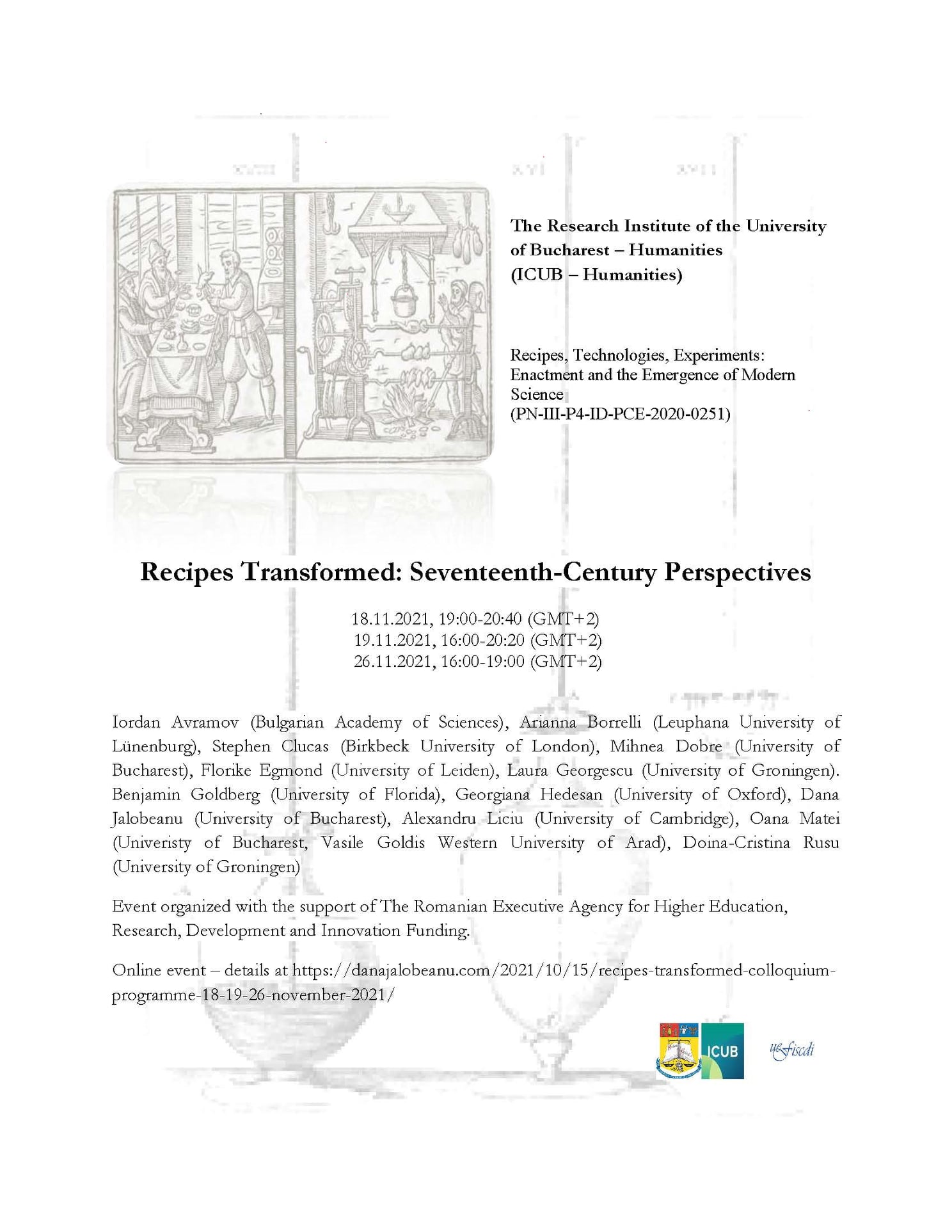
Recipes Transformed, Colloquium Programme, 18-19, 26 November 2021

ICUB-HUmanities, University of Bucharest.

First international colloquium of the research project Recipes, Technologies, Experiments: Enactment and the Emergence of Modern Science (PN-III-P4-ID-PCE-2020-0251). Online

18.11.2021

19:00- 19:20 Welcome Address

19:20-20:00 Arianna Borrelli (Leuphana University of Lünenburg) -Recipes as Tools for Concept Formation in the Work of Giovan Battista Della Porta

20:00-20:40 Dana Jalobeanu (University of Bucharest)The “Missing Results” of Bacon’s Tables: Or Reading the Novum Organum in Context

19.11.2021

16:00-16:40 Stephen Clucas (Birkbeck University of London) – Going with the Alchemical Flow: Schematizing Laboratory Technique in the Late Sixteenth Century

16:40-17:20 Georgiana Hedesan (University of Oxford)Between Incomplete and Philosophical Recipes: Deciphering Van Helmont’s Universal Medicines

17:20-18:00 Alexandru Liciu (University of Cambridge)John Woodward’s “Test” of Observation and the Issue of Civil History

18:00-18:20 Break

18:20-19:00 Laura Georgescu (University of Groningen)Philosophising with Objects: The Role of Artefacts in Digby’s Treatise on Body

19:00-19:40 Doina-Cristina Rusu (University of Groningen) – Distillations, Spirits, and Essences. Experimentation and Matter Theory in the Early Modern Period

19:40-20:20 Mihnea Dobre (University of Bucharest) Constructing Experiments with Glass Drops in Jacques Rohault’s Natural Philosophy

26.11.2021

16:00-16:40 Florike Egmond (University of Leiden) – Cultivating’ the Sea and Reading its Signs: Marine Expertise of the 16th-Century North Sea

16:40-17:20 Benjamin Goldberg (University of Florida) – Concepts of Experience in Royalist Recipe Collections

17:20-17:40 Break

17:40-18-20 Iordan Avramov (Bulgarian Academy of Sciences)Communicating Recipes and Experiments via Letters at the Early Royal Society of London

18:20-19:00 Oana Matei  (University of Bucharest, University of Vasile Goldis, Arad)- Building an Early Modern Science of Vegetation: Nehemiah Grew’s Inquiries into the “Anatomy of Plants”

Dana Jalobeanu on the Historia et inquisitio de animato et inanimato

In this seminar, Dana Jalobeanu invited us to explore one of  Francis Bacon’s lesser known texts, the Historia et inquisitio de animato et inanimato. Starting from the conditions for the apparition of animated bodies, („an enclosed spirit, heat attenuating and dilating the spirit, soft and sticky matter, and a matrix closed up for the right length of time”), Dana started an investigation into the proper place of the Historia et inquisitio in the broader context of Bacon’s corpus of texts, suggesting that it could provide a roadmap to Bacon’s unwritten 4th part of the Great Instauration.

Dana emphasized that, in this project of a systematic inquiry into the domain of animated matter, we find a convoluted, but technical, terminology (inquisitio as a more advanced part of inquiry than the mere historia; „inquisitio inartificialis et in confuso” vs. „inquisitio artificialis”). An important example of such a technical concept – on which we spent some time – are the „canones mobiles”,  i.e. flexible rules and generalizations that are evolving alongside the process of discovery (and which, as it was suggested by the audience, come from a medical tradition, for which the „canones” represent a series of rules agreed upon by the greatest physicians). The use of canones mobiles is relatively widespread in Bacon’s programme (for instance, in the De vijs mortis we are presented with such a canon: „anything that can be constantly fed, and by feeding be wholly restored, is, like the vestal flame, potentially everlasting”). The terminological discussion led to the question of how are such concepts to be organized and what can this tell us about Bacon’s programme of an experimental natural philosophy. Thus, Dana argued that we should distinguish between ”mother-histories” (the first level of inquiry) and the more advanced inquisitio (exploratory experimentation that can be done at different levels of inquiry). We also examined the theory of matter that underpins the discussion on vivification. For Bacon, „vivification” (the switch from inanimate to animate matter) occurs when the „spirits” that make up the matter are disposed in a specific structure (they are „branched”). What we obtain from this is a continuous taxonomy of the animated bodies, since this account also allows for degrees (some things are more „animated” than others). We took the discussion on step further and asked how is it possible for the artificer to produce artificial life in the laboratory. Dana showed that there are two possibilities on the table (controlling the process of „putrefaction” vs. controlling the matter), and then proposed to look closer at some steps towards the production of artificial life, such as the processes of concoction or of enclosed distillation.

The speaker also received a good number of relevant questions from the audience, such as: what is, in this context, the difference between imitating and perfecting nature? Is the whole universe animated, for Bacon? Can we divide the spirits? Can we produce better animals? What role do limit-cases play in the context of vivification (animals that live in extreme environments, deep ground that ceases to be fertile etc.)? Which sort of things can be vivified and which ultimately can not? (Can we vivify gold? How about Paracelsus’s homunculus? Why shouldn’t we try to reproduce it?) Is vivification related to density and rarity?

Oana Matei on Nehemiah Grew’s science of vegetation

In this seminar, Oana Matei presented her work-in-progress related to the way in which Nehemiah Grew planned to build a science of vegetation, with a focus of his “The Anatomy of Plants”. Oana advanced her provisional thesis that the aim of Grew’s book is to organize different processes of nature into theoretical layers, i.e. in a science of vegetation. Thus, we found out that, for, Grew, “digestion is instrumental to fermentation”, while “fermentation is subservient to vegetation”. These notions, alongside some more details on the way that Grew speaks of generation and motion, gave rise to a discussion on the proper terms that we should use in relation to Grew. Some of us tended to see him as a serious experimentalist (indicating possible connection with Robert Hooke or the medical circle to which Grew belonged), while others emphasized  the vitalistic tone of some of his phrases, or even the bits that rather belong to a mechanical philosophy.

In this context, a number of interesting questions were put on the table. Are some of Grew’s notions of Helmontian influence? In which sense does Grew use the notion of „principles” (Nitrous, Acid, Alkaline, Marine, but he also claims that the atoms are „principles”)? Are they more than mere posits? Why did Grew write an anatomy of plants? To which theoretical level does the anatomy belong? Is Grew part of a larger discussion about the merits of the Ancients vs. the merits of the moderns? (is he engaging with the Hippocratic corpus on generation?). How does Grew reconciliate a physics of processes with geometrical observations (that you only see in an instance)? Is Grew involved in a project of creating artificial life? (and how radical was this?). What is, for him, the difference between biological and non-biological entities? How is Grew’s embryology looking like (how do the structures of pre-established order get intro the seed? Are they there to begin with?).